25 Years of Community ESL
In 2002, SLU-Madrid hosted its first Community English as a Second Language (ESL) classes. University students volunteered to teach English, and members of the Madrid community were invited to develop their language skills.
25 years later, SLU-Madrid's oldest and most successful service program is stronger than ever: more than 14,000 people have studied English in the free classes, and over 1,000 students have volunteered as teachers. In one semester alone, 52 students took part.
The director of the classes, Hamish Binns, will tell you that the program offers participants a range of benefits outside of language acquisition. Students and teachers have developed long-lasting friendships, and the classes offer a unique opportunity for mutual cultural immersion. The volunteers meet people from all sorts of different places, and the students develop their English with the help of native English speakers.
Classes are offered three or four days per week, with levels ranging from beginner to advanced. Students come with a wide variety of goals for their English: job opportunities, ease of daily interactions, travel, or simply the joy of learning alongside others and meeting new people.
Students have ranged from 14 to 93 years old and come from every walk of life: bank managers, newly arrived immigrants and everything in between. Some students have been coming to classes for over 10 years. Many started with no English at all, advancing through the levels as their proficiency increases. For some students, their progress in the English classes opened work opportunities that wouldn’t have otherwise been available to them.
The volunteers reap great benefits from the program as well. For many students, it is their first time leading a classroom. They prepare and teach independently or in pairs, with training and support from the department. In spring and summer semesters, the classes are a part of the student volunteers' TESOL (Teaching English to Speakers of Other Languages) certification.
Volunteers are given the freedom to choose what to teach and how to teach it, and it is precisely this personalization that makes the classes so special. Many volunteers have gone on to become teachers, using what they learned in the program throughout their careers. Even for those who don't end up teaching, the experience equips them with skills they can use in any path they take.
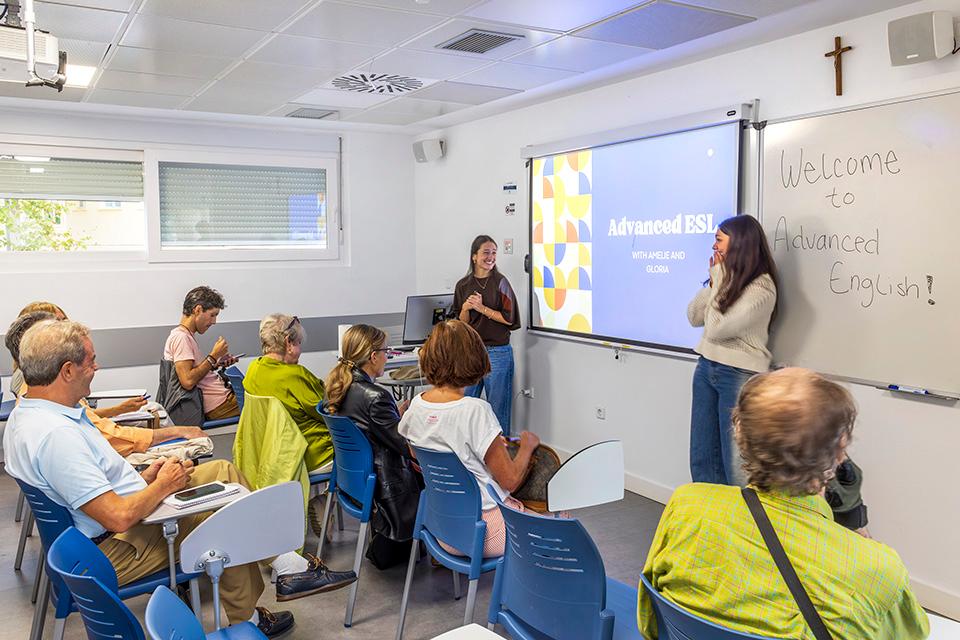
Amelie Noel and Gloria Philips are among the students teaching this year. They decided to volunteer because of their interest in working with people and the chance to step outside their usual circles in Madrid. Their advanced class brings them together with students whose experiences of the city greatly differ from their own. This brings a totally different, but valuable, kind of learning; English brings people into the room, but the conversation gives them a reason to return.
That sense of connection has carried the program through changes, too. The fall 2020 semester was the only one without classes, and teaching continued online in 2021. Students have rallied together through tragedy and illness, which highlights how unifying this program can be.
The Jesuit commitment to being "for and with others" takes a practical form here. Students give their time and carefully prepare lessons. Learners bring their questions, experience and determination. 25 years on, Community ESL continues because people on both sides of the classroom keep showing up for one another.