SLU-Madrid Hosts International Symposium on Art and the Cultural Cold War
Saint Louis University-Madrid welcomed art historians from Europe, Latin America and the United States on May 28 and 29 for the international symposium "Art and Politics in Cold War Americas."
Held in the San Ignacio Hall Auditorium, the symposium brought together scholars examining how artists, museums, exhibitions and governments shaped cultural narratives across the Americas and beyond during one of the most consequential geopolitical periods of the 20th century.
The event featured a keynote lecture by Miriam Basilio Gaztambide, Ph.D., associate professor of art history and museum studies at New York University. Her presentation, "The Museum of Modern Art: Creating a Canon and Defining 'Latin American Art' During the Cold War — The Importance of Collection Displays," explored the influential role museums played in shaping understandings of Latin American art during the period.
The symposium grew out of a collaborative research project that began approximately three years ago when Laura Katzman, Ph.D., professor of art history at James Madison University, was curating an exhibition at Madrid's Museo Nacional Centro de Arte Reina Sofía. Since then, scholars from multiple institutions have worked together to investigate the cultural Cold War through a hemispheric perspective that places the United States, Latin America and the Caribbean in conversation with one another.
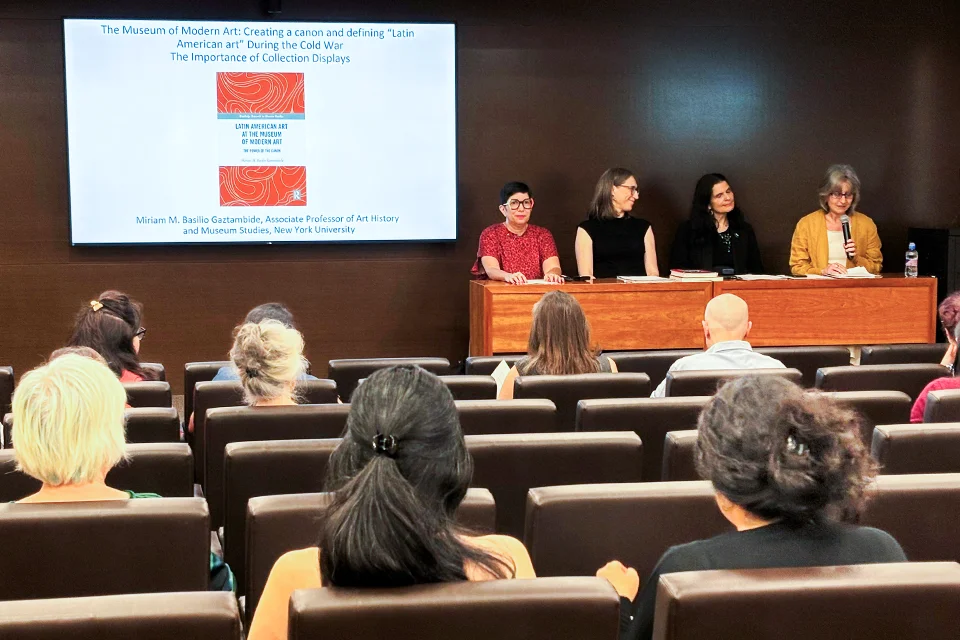
"I would like to thank the participants for working with us for the past year to prepare for this symposium. We are excited to be able to bring you together and continue our conversations about this project," said Fabiola Martínez, Ph.D., associate professor of art history and director of the art history program at Saint Louis University-Madrid.
Martínez said the project's organizers sought to challenge traditional understandings of the Cold War by emphasizing connections among countries throughout the Western Hemisphere.
"We thought a hemispheric approach was important to bring the United States, Latin America and the Caribbean into the same geopolitical space and as equal players in the cultural sphere of this critical period," she said.
Katzman noted that the symposium highlighted relationships and exchanges that often fall outside conventional Cold War narratives.
"While each country experienced the political effects of the Cold War differently, we highlight inter-American and transatlantic dialogues to reveal a multifaceted history that bypasses the binary global divide imposed by the Iron Curtain," Katzman said.
Over the course of two days, presenters examined topics including museum collections, international exhibitions, photography, abstraction and cultural diplomacy in countries such as Cuba, Mexico, Venezuela, Bolivia and the U.S. territory of Puerto Rico. Scholars represented institutions including New York University, Texas A&M University, Wake Forest University, George Mason University, Northern Illinois University, Universidad de Granada, Universidad Iberoamericana, Leibniz Universität Hannover and Saint Louis University-Madrid.
SLU-Madrid faculty members Fabiola Martínez Rodríguez, Ph.D., and Beatriz Cordero Martín, Ph.D., presented research on Mexican art and cultural diplomacy as well as abstraction in Venezuela during the 1950s, contributing to broader conversations about artistic exchange across national and ideological boundaries.
By bringing together scholars from multiple countries and disciplines, the symposium reinforced SLU-Madrid's commitment to fostering international academic collaboration and advancing research on global cultural history.