SLU-Madrid's Olivia Badoi Presents New Book on the Woodcut Book Tradition
Olivia Badoi, Ph.D. (English), introduced her recently published book "Arboreal Modernism and the Woodcut Book" with a focus on the historical and artistic significance of the craft.
The March 18 presentation in the San Ignacio Hall Auditorium brought together English students, faculty and staff to explore how artists across the globe used woodcut techniques not only as a visual medium but as a way of producing entire books. Badoi described the woodcut book as an artisanal product that combines text, image and material into a single handcrafted object.
"I was really curious as to why," Badoi said. "How could it be that a kind of book was very popular, people bought, people made it — people wrote handwritten letters to the authors who made them."
Badoi explained that, in an era of rapid industrialization, artists deliberately chose the labor-intensive process of carving woodblocks to create books by hand. These works challenged mass production and offered an alternative way of engaging with audiences.
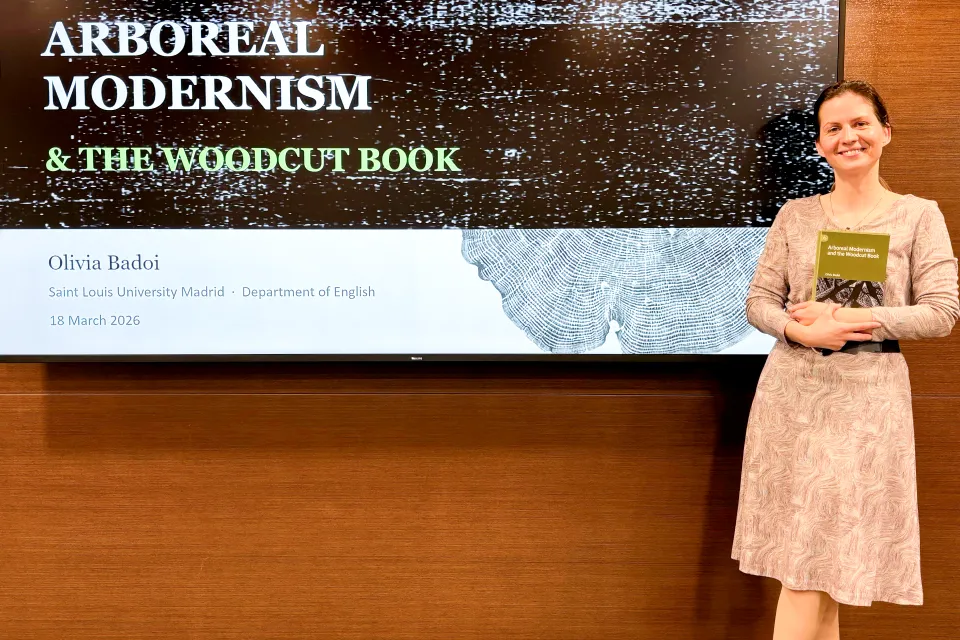
"This is a very time-consuming process and is very unforgiving, too," she said. "Imagine carving wood. If you make a mistake, there's no eraser for it, there's no going back."
Her research highlights how the woodcut book served as both artistic innovation and a political tool. Badoi pointed to historical examples such as Martin Luther's use of woodcut imagery during the Reformation, as well as broader traditions in China and the United States, where visual storytelling reflected social injustices.
"These are wordless stories told completely in images," Badoi said, emphasizing the narrative power of the medium.
Badoi's work connects early 20th-century artistic practices with contemporary concerns about ecology, craftsmanship and the human relationship with the natural world.