SLU-Madrid Professor Examines Art, Politics and the Cold War at Cambridge
Saint Louis University-Madrid faculty member Beatriz Cordero Martín, Ph.D. (Art History), presented research at the Association for Art History 2026 Annual Conference on April 9 at the University of Cambridge in the United Kingdom.
Cordero Martín's talk, "Dissenting Abstractions in Latin America: Tenth Inter-American Conference in Caracas, 1954," was part of the panel "Transcultural Abstraction, Colonial Histories," which examined the global dimensions of abstract art and its connections to colonial histories and cultural exchange.
Her presentation explored competing interpretations of abstraction during the Cold War through exhibitions presented at the 1954 Tenth Inter-American Conference in Caracas, Venezuela. While Venezuelan artists such as Alejandro Otero promoted geometric abstraction as a universal and optimistic visual language tied to modernization, the United States exhibition — organized by the Museum of Modern Art — highlighted emotionally charged abstract expressionism.
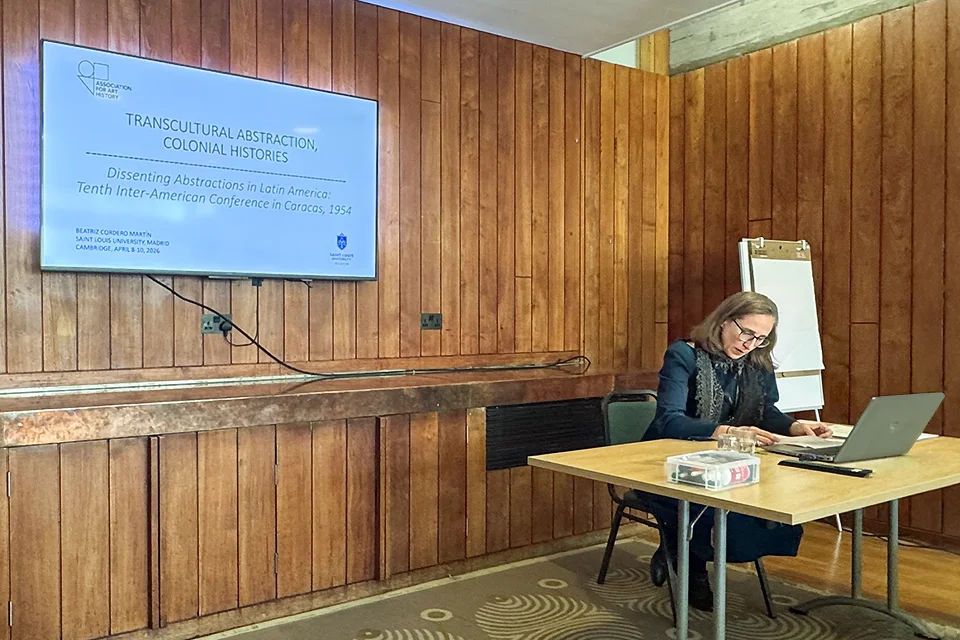
Cordero Martín analyzed how the exhibitions reflected differing political and cultural visions during a period of heightened geopolitical tension in the Americas. Her research also examined why the United States refrained from framing abstract expressionism as the culmination of American artistic traditions despite visible influences from Navajo painting and Mexican muralism in the work of artists such as Jackson Pollock.
Drawing on archival research from MoMA's International Program and the scholarship of Monica Boulton, Shifra Goldman, Claire Fox, Nancy Jachec, Ana Franco and Mariola Álvarez, Cordero Martín argued that artistic discourse during the period extended beyond traditional debates opposing figurative and abstract art.
The Association for Art History Annual Conference brings together international scholars working in art history and visual culture and serves as one of the field's leading academic gatherings.