How Can the Jesuit Tradition Shape Our Perspective on Workplace Law?
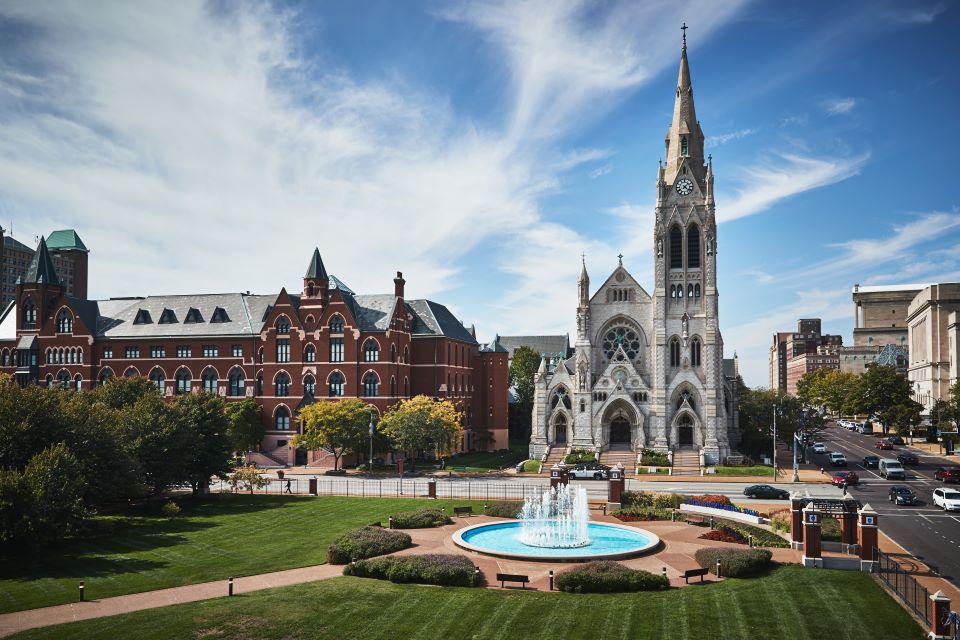
Saint Louis University was founded in 1818 by a Catholic bishop named Louis William DuBourg. Within just a few years of its founding, the Society of Jesus, whose members are known as the Jesuits, assumed control of the University. Ever since, the Catholic and Jesuit traditions have guided the University in its mission to serve a higher purpose and to seek the greater good.
As a component of SLU, we at the Wefel Center frequently consider how the Catholic, Jesuit perspective can help frame students’ views of workplace law. This is, of course, not the only perspective we consider. While the University’s mission and identity are undeniably Catholic, SLU welcomes and encourages those from all cultural and faith backgrounds to exercise and share the wisdom of their traditions. This commitment to interfaith dialogue is not only consistent with a robust and modern educational philosophy, but it is also a key component of the Jesuit mission.
Certainly, many faith traditions call upon their followers to consider and advocate for the welfare of working people. This was, in part, the subject of the Wefel Center’s 2024 Employment Law Symposium titled, “Revisiting Religion in the Struggle for Workplace Justice.” In keeping with the themes from that symposium, we thought that a good starting point for our first blog post might be to explore the Catholic church’s perspectives on workers’ rights.
With respect to labor and employment issues, the church’s views have, since 1891, been quite consistent and inspirational. In that year, amid the social and economic turmoil triggered by the Industrial Revolution, Pope Leo XIII delivered a papal encyclical titled Rerum Novarum (“On New Things”). The first papal declaration of its kind, it set forth the church’s position on the vulnerability of workers and called for a moral and economic reckoning to help ensure their protection.
In a powerful pronouncement that remains relevant today, the pontiff criticized the oppressive working conditions of the average laborer. “[B]y degrees[,]” he noted, “it has come to pass that working men have been surrendered, isolated and helpless, to the hardheartedness of employers and the greed of unchecked competition.” He went on to lament the “misery and wretchedness pressing so unjustly on the majority of the working class[,]” the unequal distribution of wealth, and the eradication of public institutions once designed to ensure working people’s protection.
To rectify these injustices, he issued several prescriptions. He endorsed: (1) the freedom of workers to unionize and collectively bargain with their employers; (2) the distribution of fair wages and the setting of reasonable work hours; (3) the elimination of unreasonably dangerous working conditions; (4) the enhanced role of state to ensure the welfare of the working class; and (5) the duty of employers “to respect in every man, his dignity as a person ...”
This last prescription, regarding workers’ dignity, is stressed throughout the encyclical. In other sections, Pope Leo stressed that “[t]he members of the working classes are citizens by nature and by the same right as the rich ...[,]” and he warned that “to misuse men as though they were things in the pursuit of gain, or to value them solely for their physical powers ... is truly shameful and inhuman.”
The lasting impact of Rerum Novarum is hard to overstate. For more than 130 years, it has shaped the Catholic faith’s position with respect to marginalized and oppressed workers. Today, the encyclical’s core tenets are woven into the “Seven Themes of Catholic Social Teaching” which serve as a guide for Catholic education at all levels (including here at SLU). These “Seven Themes” promote, among other things: (1) the dignity of work and the rights of workers; (2) the dignity of the human person; (3) the organization of social institutions for the greater good; (4) the obligation to provide for the needs of the poor; and (5) the obligation to act in solidarity for peace and justice.
The encyclical also serves as a guidepost for how we can address the dramatic social and technological shifts occurring today. This has been recognized, not only by Pope Leo, but also by secular groups and individuals who advocate for working people. Just last year, the International Brotherhood of Teamsters hosted community leaders, rank-and-file members, and members of the clergy to celebrate the legacy of Rerum Novarum and its potential to guide us through these challenging and uncertain times.
To be sure, in today’s “Second Gilded Age,” wealth is still concentrated in the hands of the few, workers are still deprived of opportunities to act and bargain collectively, and many public institutions are retreating from the responsibility of protecting working people. These are new versions of old problems, and our business at the Wefel Center is to train the next generation of lawyers to meet them. In doing so, we draw inspiration from a variety of rich perspectives, to include those outlined in Rerum Novarum.
We also draw inspiration from the Jesuit educational philosophy. Among other things, a Jesuit education encourages students to engage in “active discernment” as part of an intellectual and spiritual practice to “find God in all things.” This practice derives from the belief that God is active in our world and that the search for God entails the concurrent search for (and pursuit of) greater truth, justice, and human dignity.
To “find God” in this space is, at least in part, to pursue fairness, discern truth, and advocate for the rights of working people. This drives us to do more than just teach and learn the current legal doctrine. It urges us to explore and understand the history and impacts of our legal frameworks so that we can then discern why they are needed and whether they are fulfilling a just purpose.
Labor and employment laws are swiftly changing. As they evolve, legal practitioners will be called upon to hold them to account. At SLU, we seek to provide a well-rounded educational experience that will prepare our students to heed that call.
For more information on Rerum Novarum and perspectives on religion, law, and the workplace, check out the Wefel Center’s 2024 symposium titled, “Revisiting Religion in the Struggle for Workplace Justice.”