From the Bedside to Capitol Hill: Fabian Lucero’s Career at the Forefront of Health Advocacy
For Fabian Lucero ('20), a career in health policy began long before he came to Saint Louis University School of Law.
Working 12-hour night shifts in a cardiovascular intensive care unit while attending community college and later studying public health at the University of Arizona, Lucero began thinking about how law and policy could shape healthcare beyond individual patient encounters.

“I was learning about health inequities while seeing them firsthand at the bedside and realized I wanted to make greater change through federal health policy and legislation,” he said. "I invented health policy in my 21-year-old brain by wanting to couple my hospital experience with the law; luckily I found out it was already a well-established practice with [SLU’s Health Law Program] leading the way."
Today, Lucero serves as director of federal advocacy at PhRMA and as a captain, judge advocate in the U.S. Army Reserve. His career has taken him from hospital floors to Capitol Hill and placed him at the center of some of the nation's most significant health policy debates.
One of the defining moments of Lucero's career came in 2022, when he was on the floor of the U.S. House of Representatives as Democrats passed the Inflation Reduction Act. The legislation included a number of significant healthcare reforms: extending Affordable Care Act premium tax credits through 2025; requiring cost-sharing-free coverage for Advisory Committee on Immunization Practices (ACIP)-recommended vaccines under Medicaid, CHIP and Medicare Part D; capping insulin costs for Medicare beneficiaries at $35; establishing a $2,000 annual out-of-pocket cap for Medicare Part D beneficiaries; and allowing Medicare to negotiate prescription drug prices for the first time.
Lucero recalled congratulating Speaker Nancy Pelosi after the bill's passage. But what stands out to him most now is how that legislation illustrates the complexities of health policymaking. Currently, in his role at PhRMA, he advocates on issues related to the law's implementation, including the unintended consequences of Medicare Part D reforms and drug price negotiations that could jeopardize the U.S.’s leadership in drug development. “It just goes to show how complicated health policy is and when you pull a lever somewhere, it disrupts another piece of the puzzle,” he said. For Lucero, the experience underscores the complexity of health policymaking and the tradeoffs that often accompany major reforms.
That same understanding informs his work today. Lucero spends much of his time helping policymakers better understand the impact of disease prevention and medical innovation. “My job as of late, has been arming congressional staff with relevant data on disease prevention and showing the utility of our medicines, like the HPV vaccine that has decimated cervical cancer in women,” he said. “That is nothing short of a miracle.”
The policy issue he feels most passionate about currently is the impact of the “the dramatic cuts to the social safety net contained in the One Big Beautiful Bill Act,” he said. “In my home state of Arizona, half of SNAP recipients — 461,272 people — have already been cut off the rolls at a time when inflation and tariffs have dramatically increased the price of food.
The concerns he raises now echo research he conducted while at SLU Law. “Thanks to the guidance of Professor Sidney Watson who advised me on my [Journal of Health Law & Policy] note, I wrote about section 1115 Medicaid waivers which allowed Kentucky to implement work requirements,” he said. “We saw then what we see now: 1) adding work requirements adds paperwork to our nation's most vulnerable and kicks off people who qualify for the program; and 2) people who are healthy are able to work; working does not make people healthy."
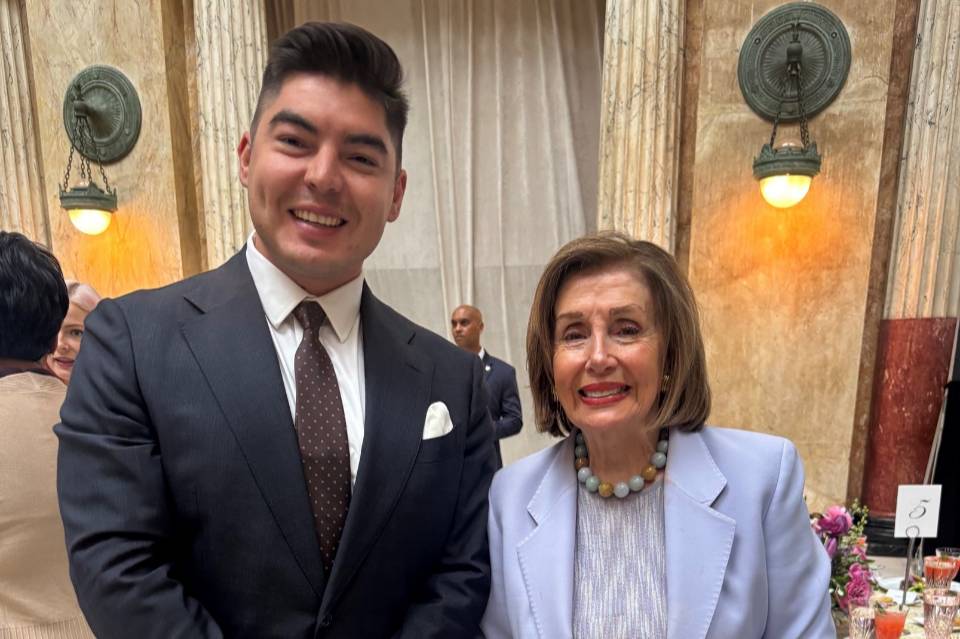
His interest in Medicaid policy grew into a broader appreciation for the many ways health policy shapes communities and outcomes, a perspective he traces directly to his time at SLU Law. Looking back, Lucero credits the Center for Health Law Studies with helping him transform that passion into a career.
“The institution itself being a powerhouse of health law and policy in academia opened its arms to me.” Before SLU Law, he was “someone who was passionate without necessarily knowing how to direct that passion into concrete steps through the values of a Jesuit education — to be in the service of others.”
Lucero credits two other faculty mentors with helping shape his career. Through the Center for Health Law Studies’ Semester in D.C. program, he had the opportunity to immerse himself in the policymaking environment of the nation's capital while exploring his own professional interests. He says the mentorship he received from Executive Director Amy Sanders and Professor Malcolm Harkins during that key time encouraged him to think more deeply about the influence of federal health policy and helped solidify his interest in advocacy.
Outside his work in federal advocacy, Lucero continues to serve in the Army Reserve JAG Corps. Most recently, during a field exercise, he served as part of a team advising a medical brigade commander on how to comply with international law, national law, and Army regulations to ensure continuous medical operations. The experience offered not only professional challenges but also a reminder to appreciate life's simpler moments. “Sleeping in a tent every night in the woods with showers only every three days makes you more thankful for what you've got back home,” he said. “But it also gives you the chance to unplug and see the stars.”
For students interested in using law to improve health outcomes and advance systemic change, Lucero believes legal training opens doors and creates opportunities to make an impact. A J.D., he said, “gives you credibility in rooms where being a lawyer is respected; it puts a feather in your cap that says you can work hard and analyze a problem and develop a solution.”
He encourages students to use that credibility to improve the communities they serve. “Use this to your advantage and get into the places that are making meaningful change in your community from the inside,” he said. “And if that doesn't work, file suit!”
He also offers one more piece of advice: Join the Supreme Court Bar. Lucero notes that it is “very easy to do,” “sounds impressive,” and provides opportunities to sit in on oral arguments on issues ranging from mifepristone access to tariffs.
For Lucero, one lesson has remained constant throughout his career: “All policy is health policy.” From Medicaid and vaccine access to pharmaceutical innovation and food security, the decisions that shape health are often made far beyond the walls of a hospital. Through his work in advocacy, public service, and the law, he has built a career helping shape those decisions.