School of Medicine Learning Communities Bring Cura Personalis Full Circle
Ohio native Elizabeth D’sa, a fourth-year student at Saint Louis University School of Medicine, still remembers the isolation of starting medical school in a new city. It’s why support from the student mentor in her learning community meant so much.
Check-ins were simple, D’sa said: asking about class, connecting her with faculty or inviting her for coffee.
But the consistent, intentional care?
“It’s just woven into the fabric of what SLU is,” D’sa said. “No matter what organization or what service or whatever group you’re a part of, the cura personalis — the care for the whole person — is just there.”
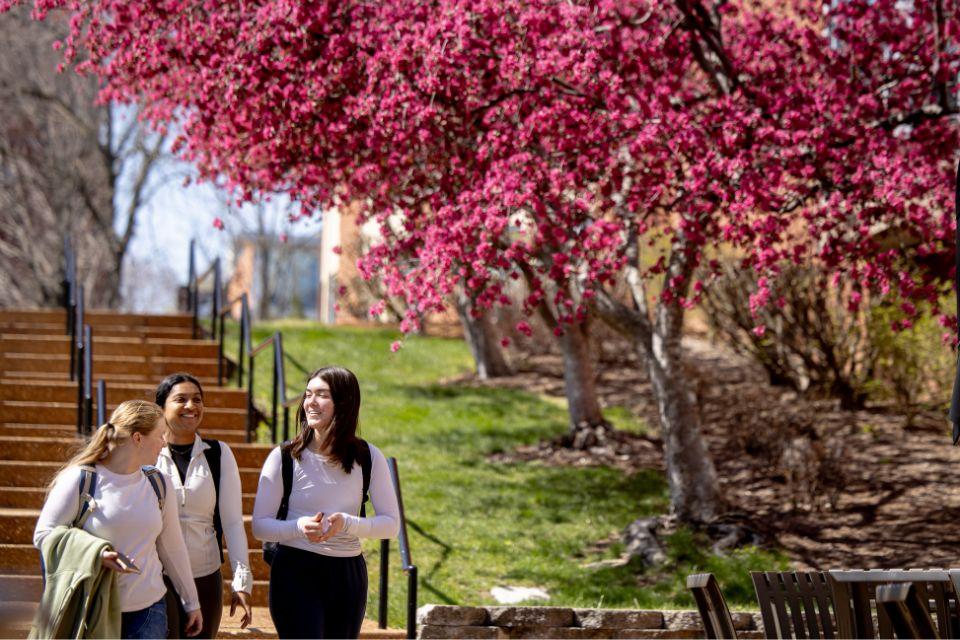
Learning communities are by no means new. Like many medical schools, SLU uses the model as a continuous resource for personal and professional connection; students receive peer- and faculty-led guidance as they progress through their training, and many, in turn, offer their own peer mentorship in the years that follow. There are social events, career development opportunities and physician-educators dedicated to helping each person succeed.
But perhaps SLU SOM’s definition of success, and the inspiration behind it, is what makes these environments so distinct.
Take the six learning communities, each named after a figure or educator who shaped the school’s legacy. The list boasts Irene D. Long, M.D., a leader at the Kennedy Space Center; William Sly, M.D., an internationally renowned researcher; and Edward Doisy, Ph.D., a Nobel Prize-winning professor. Alongside them, though, are Cindy Fairchild, an admin known for comforting students before exams; Michael T. Railey, M.D., celebrated for decades of serving the St. Louis community; and James Swierkosz, Ph.D., a teacher remembered for personalizing test questions with the names of current students.
The list speaks not only to academic achievement, but to the importance of each individual’s role, said D’sa, now a student co-chair of the learning communities.
“The person you are? That’s also lasting,” she said. “Yes, we want you to be very academic and things like that, but we also want you to be a good person.”
Living the Mission
Mentor Cindy Bitter, M.D., an emergency medicine professor, said her learning community role is a mix of den mothering, coaching and cheerleading. Involved in the program since its 2019 start, Bitter wears many hats: taking students to Ted Drewes Frozen Custard or a quick meal at Crave; grilling them about healthy habits; connecting them with resources; helping them discover a specialty; and, generally, making sure they do more than just study.
This focus on well-being is central to how SLU SOM helps students develop as whole people, Bitter said, and it’s bolstered by a curriculum that doesn’t shy away from examining how social determinants, racism, ableism and disability affect patient care.
Plus, she gets to watch students pay it forward.
“It’s really rewarding for them to realize, ‘I have some things I can help the next class with. I’ve seen some stuff. I made it through this, and I know how to get through this,’” Bitter said.
Full-circle discovery is common at SLU. Mentor Anjani Urban, M.D., a SLU SOM alumna and assistant professor of family medicine, said she has always loved how the University helps students pursue the educational experience and career they want. In fact, when Urban was a student, Swierkosz himself was her advisor. She still uses copies of a flowchart he’d give students to help them determine which medical specialty was the best fit.
Urban said learning communities help to standardize that type of mentoring experience, which ensures every student — no matter their interests or passions — benefits from having that same guidance and built-in community.
“It’s not about pigeonholing students to a certain stereotype or certain personality type. It’s about helping them figure it out for themselves,” she said.
The Next Chapter
D’sa said her learning community experience has confirmed her desire to continue supporting and mentoring students later on in her career. She currently hopes to pursue an internal medicine residency and cardiology specialty.
And yet, moving forward, she’ll remember to look back.
“As someone who wants to be more in an academic setting, I’m just keeping in mind how they modeled it for me and how I should be for students I work with in the future,” she said.