Centralizing Understanding of Liver Disease
The Saint Louis University Liver Center stands as a beacon for liver care, education and research. But decades ago, it was simply a dream shared by two renowned hepatologists.
Bruce R. Bacon, M.D., and Adrian M. Di Bisceglie, M.D., spent their initial years at SLU devising a center committed to excellence in patient care, basic and clinical research, and medical and public education in liver disease. Together, they launched the Liver Center in 1994, and unprecedented momentum followed.
The Liver Center quickly gained international acclaim for its research and treatment of patients with chronic liver diseases. By 2001, the Liver Center was designated as a center of excellence — uniting investigators and clinicians across disciplines. Today, the center is composed of 50 specialists from 11 departments and divisions. Wing-Kin Syn, M.D., Ph.D., director of the Division of Gastroenterology and Hepatology and co-director of the Liver Center, shared that they remain united in their passion for progress.
“We are committed to excellence,” Syn said. “Physicians and scientists are working side-by-side to acquire new knowledge of liver function, disease origins and applicable treatments.”
Our Mission in Motion
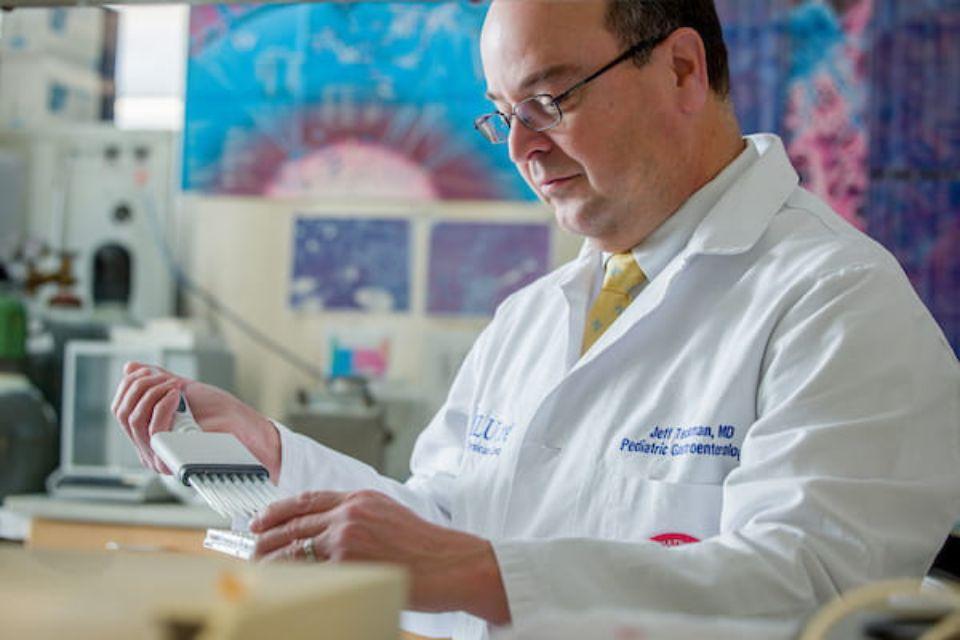
Current projects within the Liver Center expand upon the foundation established by Bacon and Di Bisceglie. Jeffrey Teckman, M.D., professor of pediatrics and biochemistry and molecular biology, noted that he sees their mission carried out through ongoing discovery.
“The Liver Center once played a key role in the cure of hepatitis C,” Teckman said. “Now, similar advances keep SLU at the forefront of internationally recognized developments.”
For the past 30 years, Teckman has researched novel therapeutic approaches for alpha-1 antitrypsin deficiency (AATD) — a liver disease affecting one in 3,500 Americans. Teckman’s progress has intensified in recent years. In 2022, his lab helped to establish Fazirsiran as the first viable treatment for this disease, apart from a liver transplant. In 2024, his team identified predictive biomarkers in high-risk infants for the first time. In 2025, Teckman observed that norUDCA also reduces harmful protein accumulation — suggesting the need for human trials in the future.
“My lab maintains a strong record of translational work of which we are proud,” Teckman said. “So far, four human clinical trials have arisen from our discoveries and pre-clinical animal studies.”
Meanwhile, Brent Neuschwander-Tetri, M.D., professor of internal medicine, has spent 20 years conducting research for the Nonalcoholic Steatohepatitis Clinical Research Network (NASH CRN). With permission, Neuschwander-Tetri collected genetic sequences from thousands of patients, hoping to use this data to accelerate the understanding, diagnosis and treatment of metabolic dysfunction-associated steatotic liver disease (MASLD).
"Similar advances keep SLU at the forefront of internationally recognized developments."
Jeffrey Teckman, M.D.
Neuschwander-Tetri and his team finalized patient visits in summer 2025 — freeing them to parse through the data and, eventually, share their findings with the medical community. Syn emphasized that work conducted by Teckman, Neuschwander-Tetri, and other Liver Center specialists will accelerate progress in this evolving area of medicine.
“The incidence of liver disease is rising,” Syn said. “It is increasingly important to support research that will enable earlier diagnosis, yield effective treatments and facilitate public education.”
Looking ahead, Liver Center specialists will advance innovative research to grow understanding of liver disease. Syn plans to use artificial intelligence to investigate the genetic variants of cholestatic liver diseases, while Lewis Frey, Ph.D., professor of gastroenterology and hepatology, will use artificial intelligence to predict liver disease outcomes.
This story originally appeared in Grand Rounds magazine.
About Grand Rounds
Grand Rounds is the alumni magazine of Saint Louis University School of Medicine, distributed to alumni and supporters. The magazine includes medical school news, feature stories, alumni and student profiles, and ways to stay connected.