From Program to Purpose: Summer Outreach at SLU School of Medicine
For some St. Louis-area teens, a career in medicine starts with a cadaver on summer vacation.
Just ask the 24 high school students who spent all of June in the Summer Scholars Program at Saint Louis University School of Medicine. The group balanced research and presentations with hands-on training, but few activities matched the impact of studying a real human body.
“Something they don’t cover in school, even if you take a million classes about medicine, is where organs actually are and what order they come in,” said Zeke Dubale, a senior at Francis Howell North High School. “Figuring that out was really interesting. The cadaver lab’s an experience I don’t think I’m going to get again for a very long time.”
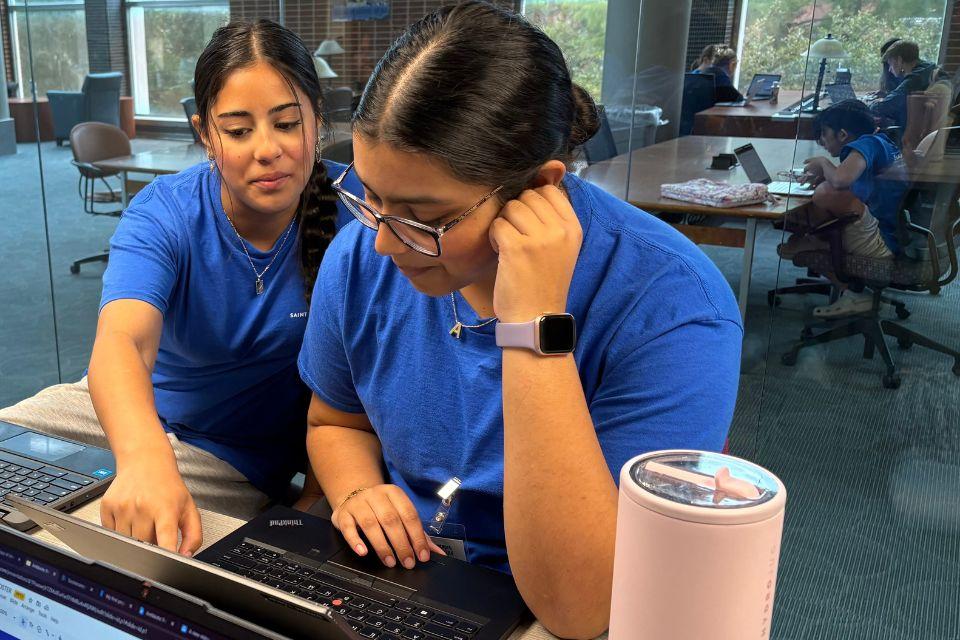
Opportunities like these set SLU SOM’s summer outreach programs apart, but the real magic is in the University’s long-term commitment: walking alongside students who are exploring a career in medicine. Depending on the program, students might also learn about the med school application process, work-life balance, medical specialties, research projects or community impact.
The approach isn’t just an admission strategy; program leaders want to show each teen how, whatever their passion, they can find their own perfect fit in the medical world.
“Just because you’re going to be a physician doesn’t mean that you’re going to quit being a person,” said Tim Murrell, Ed.D., program director for pathway development, student engagement and retention in the Office of Ignatian Mission in Medicine.
Demystifying Anatomy
Many middle and high school students looking for early exposure to medicine turn to SLU SOM’s Adventures in Medicine and Science (AIMS). Started nearly 30 years ago by father-son duo Paul A. Young, Ph.D., and Paul H. Young, M.D., AIMS offers year-round programming that includes laboratory experiences, auditorium presentations, surgical demonstrations and distance learning.
Out of the 7,000-plus students who attend sessions each year, 42 enrolled in the AIMS Medical and Surgical Procedures Workshop, held June 22-26.
Jill Martin, Ph.D., program coordinator, said AIMS distinguishes itself from other programs by offering hands-on, guided learning that demystifies anatomy and helps students comprehend the real-world consequences of decisions.
“That’s what AIMS is known for, taking really complex things and breaking them down in ways that make sense and also are applicable to daily lives,” Martin said.
Students keep coming back for more.
Take Alison Schaecher, a junior at Visitation Academy who was attending the workshop for her third consecutive year. She said the well-rounded, one-of-a-kind experience has given her opportunities she never imagined she’d have.
“If you don’t know exactly what you want to do in medicine or if you know exactly what you want to do in medicine, it’s just so cool,” she said.
Eli Ackermann, a SLU sophomore on the pre-med track, attended multiple AIMS programs while in high school and returned to the workshop this year as a counselor. Ackermann said his experiences with AIMS helped hone the interest he already had in science and medicine.
“To hear from these doctors about what their paths were like, what their jobs were like — that just grew my passion,” he said.
Hands-On Healthcare
High school students wanting a comprehensive introduction to the world of healthcare can apply to the competitive, four-week Summer Scholars Program. SLU SOM’s Office of Ignatian Mission in Medicine has offered it since 2010 to inspire students of all backgrounds and experiences to pursue health-related careers.
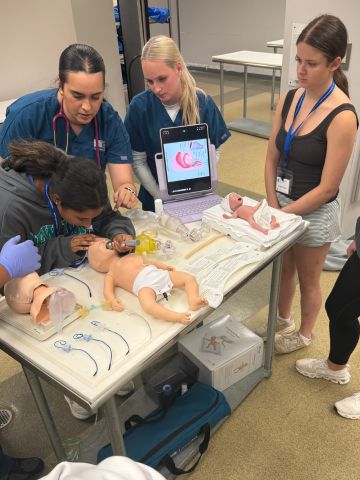
This year, students engaged in a mix of training and college prep: a cadaver demonstration, career exploration, community service, simulation labs, ACT prep, Stop the Bleed certification, research and more.
Becca DeGraeve, teaching assistant and a second-year SLU medical student, said that kind of overview is crucial for students who are just starting out.
“It’s easy to cling to one idea of what you want to do. You need the opportunity to be exposed to what you didn’t know you would enjoy,” she said.
Case in point: research — a newer component of the program that, despite their initial hesitation, students have found really valuable, Murrell said. Each student’s research experience was cumulative. After a small, introductory project and literature review, they selected a topic for a larger project and ultimately gave a poster presentation of their work.
Research from this year’s cohort included projects on neuroplasticity and recovery after traumatic brain injury; sickle cell disease and gene therapy treatment; and chemotherapy versus immunotherapy.
From hands-on activities and research to physician and medical student panels, the goal of the Summer Scholars Program is to give high schoolers who are aspiring physicians a roadmap of what to expect and how to prepare, Murrell said.
Mission accomplished.
“The research you do here, the experience you get here, is college level,” Dubale said. “It’s not going to be anything you’ve ever done before. You should be ready for that. But in addition, you need to be excited for that.”
A Holistic Path to Medicine
True to the University’s mission of caring for the whole person, Summer Scholars Program presenters reminded the cohort that a medical education should exist with, rather than replace, other passions and experiences. That’s because it’s important for students to understand they can choose almost any undergraduate major and still be a doctor, Murrell said.
“There’s a whole wide world out there,” he said. “Don’t give up your part of the world just because you want to be a doctor.”
That holistic outlook has shifted perspectives about the med school admission process. Krithika Gopu, a junior at Fort Zumwalt West High School, said it was heartening to know she could showcase other aspects of her life, rather than putting all her focus on academics.
Schaecher said the path to med school often feels intimidating, but hearing AIMS presenters share their journey put her mind at ease.
“It’s being able to take a step back and be like, ‘Okay, you can get there. It’s not impossible,’” she said.
About SLU School of Medicine
Established in 1836, Saint Louis University School of Medicine has the distinction of awarding the first medical degree west of the Mississippi River. The school educates physicians and biomedical scientists, conducts medical research, and provides health care on a local, national and international level. Research at the school seeks new cures and treatments in five key areas: cancer, liver disease, heart/lung disease, aging and brain disease, and infectious diseases.