SLU Hosts Annual White Coat Ceremony for New Medical Students
Surrounded by faculty, family and friends, 182 incoming Saint Louis University School of Medicine students took an important step in their journey to becoming physicians during the annual White Coat Ceremony. The milestone event was held Sunday, July 26, at St. Francis Xavier College Church, where students donned their first white coats and reflected on the responsibilities, privileges and calling of the medical profession.
Watch: 2026 White Coat Ceremony
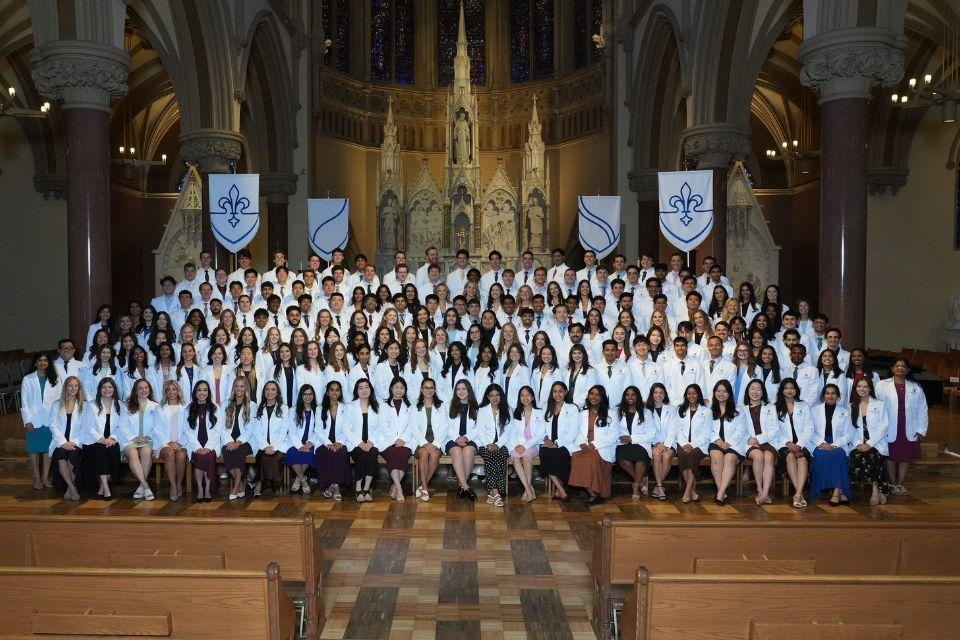
A common theme echoed throughout the ceremony: the white coat is more than a garment — it is a symbol of trust, service, compassion and the lifelong commitment to caring for others.
Speakers reflected on the significance of the white coat through the lens of Saint Louis University's Jesuit mission of cura personalis, or care for the whole person. While each offered a unique perspective, all emphasized that medicine is not simply a career, but a vocation grounded in humanism, responsibility and a commitment to serving patients with dignity and respect.
During his welcome remarks, Adam Merando, M.D., associate dean of student affairs, described the white coat as the "symbolic representation of the intrinsic trust" students will earn from their patients. He encouraged the Class of 2030 to wear the coat with humility, respect and pride, reminding them that becoming a physician requires more than academic achievement.
"The commitment to being a doctor is more than just the grades you will earn in the classroom," Merando said. "Rather, it is a commitment to high moral standards, compassion toward all and a humanistic approach to the care of your patients."
Christine Jacobs, M.D., dean of the School of Medicine, framed the white coat within the context of the professional oath students will take as physicians. She noted that the ceremony marks the beginning of a lifelong pledge to provide compassionate care and treat every patient with dignity, regardless of circumstance.
Building on that message, Chad Miller, M.D., senior associate dean of undergraduate medical education, emphasized the tradition and legacy associated with the white coat. He reminded students that they are joining generations of physicians who have dedicated themselves to caring for others.
"I hope you feel different when you put that white coat on today," Miller told the Class of 2030. "You will carry the legacy of students and faculty who have come before you. You are now part of the Saint Louis University School of Medicine tradition."
Guest speaker Sean Goretzke, M.D., division director, vice chair of education, and associate professor of neurology, offered a personal perspective shaped by more than three decades in medicine. Though physically light, he said, the white coat is "one of the heaviest coats" a person can wear because it carries the hopes, expectations and trust of patients and their families.
"It is not a coat of armor," Goretzke reflected. Instead, he described it as a symbol of vulnerability — one that calls physicians to remain present, compassionate and deeply connected to the people they serve. Drawing on lessons from his career and military service, he encouraged students to embrace the human side of medicine and never lose sight of the privilege of caring for others.
Words of Encouragement and Personal Reflection
Touching moments throughout the event underscored the values at the heart of the medical profession. School of Medicine alumni and members of the Class of 2026 welcomed the incoming students into a supportive community of physicians, mentors and lifelong learners, emphasizing the importance of resilience, service and the relationships that sustain students throughout medical school and beyond.
To conclude the ceremony, the Class of 2030 stood to recite the Hippocratic Oath, led by newly inducted members of the Gold Humanism Honor Society. Faculty and physicians in attendance joined them, reaffirming their commitment to the ethical practice of medicine.
The moment left a lasting impression on many students.
“The recitation of the Hippocratic Oath was the most memorable and striking part of the ceremony for me,” said William Azrak, a first-year medical student. “I didn't realize we would be taking the oath during the ceremony, and, nearly as much as receiving the white coat, it signified the beginning of my career in medicine.”