Community of Scholars
The Saint Louis University CREST Center proudly offers a Community of Scholars Program. Below is a list of current SLU CREST Community of Scholars members associated with the 2026-2027 Project, "Formation and Generative AI."
2026-2027 Cohort

Elizabeth Sweeny Block, Ph.D.
Project Title: "Moral Formation and Artificial Intelligence"
Block’s project is part of a book on conscience and moral agency in the context of social sin and structural injustice. This chapter will examine the many ways humans are formed and shaped as moral agents, the need for more deliberate, intentional formation, and the impact that AI may have on the labor of moral agency. Among the issues to be considered is the outsourcing of moral deliberation to AI and how sidestepping the labor of moral agency is detrimental to moral formation. Block will also consider the ways that the very existence of AI, its use by others, and its impacts on the environment raise questions about and impact moral agency.
Elizabeth Sweeny Block is Associate Professor of Christian Ethics in the Department of Theological Studies at SLU. She earned her Ph.D. from The University of Chicago Divinity School, her M.T.S. from Candler School of Theology at Emory University, and her B.A. in Theology and Psychology from Georgetown University.

Xiaowen Chen, Ph.D.
Project description: Generative Artificial Intelligence (AI) is rapidly transforming how organizations design jobs, allocate work, and make human resource management decisions. Many corporations adopt AI primarily to achieve short-term efficiency gains, such as automating routine tasks and replacing entry-level jobs to reduce labor costs. Yet, the long-term impacts on workforce development and talent pipelines are often overlooked. The proposed project will systematically examine the potential misalignment between short-term organizational objectives for AI adoption and the long-term sustainability of talent development. Specifically, this project will investigate how AI-driven automation of entry-level work may affect career pathways, disrupt organizational talent pipelines, and influence the broader labor market. By integrating insights from organizational research, professional discourse, and stakeholder interviews, the project will offer recommendations for responsible AI implementation in corporations and for higher education, preparing graduates for an AI-transformed workplace.
Xiaowen Chen is an assistant professor of industrial/organizational psychology at Saint Louis University. Her research focuses on cross-cultural management, personnel selection, assessment tool development and validation, machine learning and equal employment law compliance. She teaches courses in job analysis, performance appraisal, machine learning applications in psychology, equal employment opportunity laws, leadership and industrial training. In addition to her academic work, she provides consulting services to business and industry.
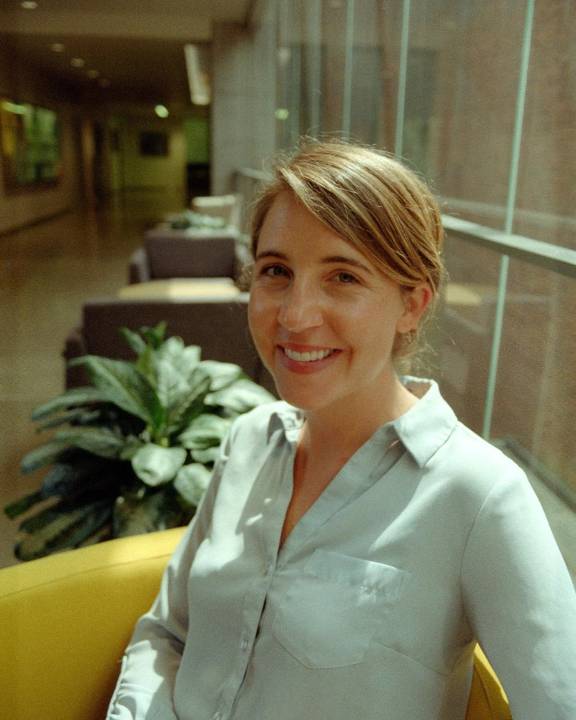
Shiloh Deitz, Ph.D.
Shiloh Deitz's interdisciplinary research spans disability studies, data/algorithm ethics, and the sociology of infrastructure. Her CREST project focuses on the limits of generative AI, which are particularly evident for those whose bodies and needs fall outside the norm. Drawing from disability justice theory and science and technology studies, she systematically audits large language model outputs for bias, stereotyping, and limited generative potential — working toward a framework that centers disability justice as a standard for evaluating AI and algorithmic systems.
Recent publications include "Outlier Bias: AI Classification of Curb Ramps, Outliers and Context" in Big Data & Society, "A Humble Proposal for GeoAI" in Canadian Geographies, and "GIScience II: Disability GIS" in Progress in Human Geography. Deitz holds a Ph.D. in Geography from the University of Oregon and joined Saint Louis University's Department of Sociology and Anthropology in 2024.

Alesha Durfee, Ph.D.
Project title: “AI and Technology-Facilitated Gender-Based, Sexual, and Domestic Violence”
This year, I will be creating an interactive exhibit that critically analyzes the links between artificial intelligence and gender-based, sexual, and domestic violence. The United Nations (2024) estimates that globally one in three women will be sexually assaulted or victimized by an intimate partner in their lifetime. In the United States, nearly half of all women and one in six men will experience some form of contact sexual violence in their lifetime; more than 1 in 10 women and 1 in 14 men will experience technology-facilitated sexual violence (Centers for Disease Control, 2024).
Arts-based, community-centered efforts have proven effective strategies for sexual and domestic violence education, intervention, and outreach. This exhibit will be designed to educate people about the linkages between AI and technology-facilitated violence, link survivors to services, and provide participants with ways to get involved with these issues. It builds on the exhibit “Standing Up Against Sexual Violence” created for Denim Day and Sexual Assault Awareness Month in Spring 2026 through an 1818 Community Engagement Grant with City Sewing Room and SAM Sexual Assault Support and Advocacy Group.
Alesha Durfee, Ph.D., is a professor of women’s and gender studies and the author of more than 40 peer-reviewed journal articles and book chapters, most of which focus on gender, violence, the legal system, and social policy. Her work has been funded by the National Institute of Justice, the National Science Foundation, the Center for Victim Research, and the Ford Foundation. Durfee is also a deputy editor of Feminist Criminology. She was awarded a Catalyst Award at Arizona State University for her work on the Clothesline Project, which contributed to a more welcoming space for survivors on campus. Fall 2026 will be the third year she has hosted the Clothesline Project here at SLU

Nori Katagiri, Ph.D.
My project examines how ethical commitments by AI manufacturers shape their relationships with political actors in Washington, D.C. It centers on the ethics-based political conflict between Anthropic and the Trump administration, focusing on the latter’s decision to discontinue use of Anthropic’s programs. The controversy followed Anthropic’s refusal to comply with government mandates. Specifically, despite the chance of facing blacklisting and losing out to rival companies, Anthropic declined to permit its Claude models to be used for domestic surveillance and autonomous weapons systems.
There were three aspects of its opposition to government policy. First, AI was seen as not reliable enough to be used in autonomous weapons and could endanger civilians and warfighters. Second, using advanced AI for domestic surveillance was incompatible with democratic values. Finally, there were perceived risks of AI used without human oversight. I plan to explore these challenges that Anthropic faced.
Nori Katagiri is a professor of political science and coordinator/director of international studies at Saint Louis University. He holds a Ph.D. in political science from the University of Pennsylvania. He is the author of "How Liberal Democracies Defend Their Cyber Networks from Hackers" (Palgrave, 2024) and “Artificial Intelligence and Cross-Domain Warfare: Balance of Power and Unintended Escalation,” Global Society. He is associate editor of Global Studies Quarterly, a journal of the International Studies Association.

Steven Rogers, Ph.D.
Project title: "Missouri Voters’ Opinions on Artificial Intelligence and Data Centers"
Rogers’s project examines how Missouri voters evaluate the development of AI-related infrastructure, such as large-scale data centers, using the February 2027 SLU/YouGov Poll, the only regular public, statewide survey of Missouri voters. Building on previous findings showing skepticism toward both artificial intelligence and data center development, the survey will measure attitudes toward building data centers in Missouri and in local communities, government incentives used to attract technology infrastructure, and concerns about environmental and energy impacts.
The project will generate new empirical evidence about how citizens evaluate the trade-offs associated with AI infrastructure. Findings will be disseminated through media releases and the posting of publicly available data to support future research on technology policy and AI governance.