The Cognitive Cost of Artificial Intelligence
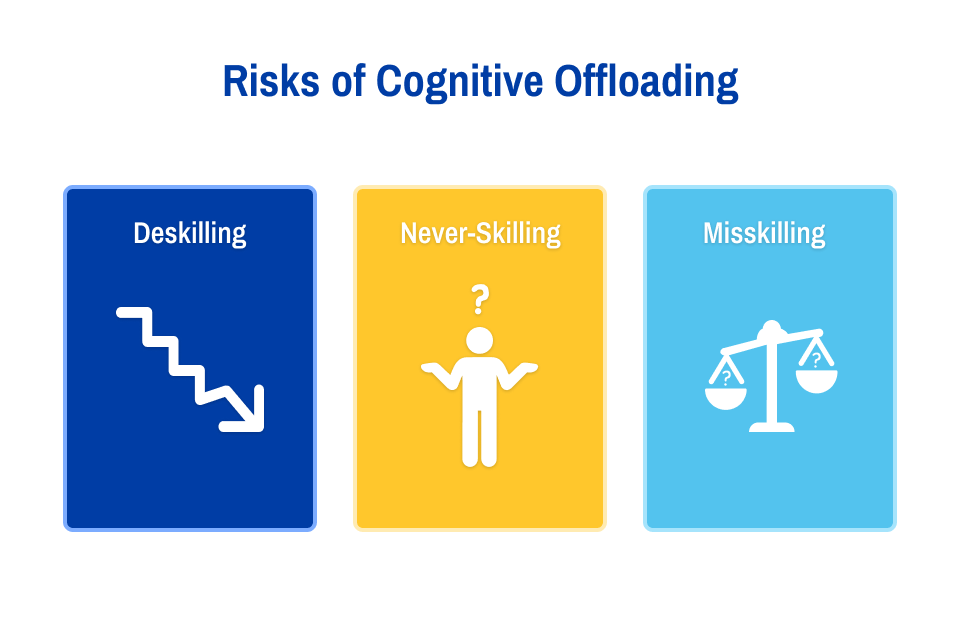
As artificial intelligence (AI) and large language models are becoming more popular with educators and trainees, the convenience of this new technology carries a quiet risk. This post asks how medical and biomedical educators can support trainees in using AI while protecting the independent reasoning at the heart of education. Three distinct hazards are deskilling, never-skilling and misskilling.
Cognitive Offloading and Its Risks
A prior CEDAR Community Blog post introduced large language models and discussed ways that educators might utilize them along with their limitations. As these tools are becoming increasingly utilized, a subtler challenge emerges for educators: not whether learners will use AI, but how it impacts their thinking. Much of AI’s appeal lies in cognitive offloading, which is the practice of shifting mental work onto an external aid to free up working memory. Offloading is not inherently harmful, as delegating routine recall can free a learner to concentrate on harder problems. The primary concern, however, is that the work being handed off is the very reasoning that medical training exists to build, and a trainee who never builds that reasoning cannot catch the tool when it is wrong.
A growing body of evidence suggests this concern is well founded. Recently, final-year medical students were asked to assess the answers that GPT-3.5 produced for ten clinical scenarios, five of which it had answered incorrectly. Only a median of 56% of students judged the outputs correctly. A recent review on the clinical supervision of AI use synthesizes findings like these and names three distinct ways that learning can go wrong when reasoning is outsourced too readily.
Deskilling
The first is deskilling, defined as the erosion of an ability that has already been acquired. For example, a resident who once built a differential diagnosis unaided may find that after months of using AI first, the skill has quietly faded as a result of disuse. Deskilling can even affect foundational abilities such as recall. Because the loss is gradual and largely invisible, it can go unnoticed until the moment the skill is unavailable or incorrect.
Never-Skilling
Another worry is never-skilling, where the ability is never developed. When a learner relies on AI before building a skill, the mental scaffolding that normally supports later expertise never has a chance to form. For example, a trainee that always lets AI draft an assessment and plan may never learn to construct one for themselves.
Misskilling
The third risk, called misskilling, is when learners absorb the errors and biases of the tool itself. In a randomized study, clinicians shown systematically biased AI predictions became measurably less accurate even with the model’s explanations, with the harm falling hardest on those who had weaker performance to begin with. A learner who is unable to distinguish a sound suggestion from a flawed one may not be in a position to catch the flaw and may instead understand it as correct. If left unchecked, biased lessons may become habit.
Preserving Critical Thinking
The risk of cognitive offloading does not suggest that AI should be excluded from the learning environment, which is neither realistic nor desirable. Rather, this post argues for protecting critical thinking as one of the skills that matters most in medical training. Practically, that means asking learners to reason through a problem before reaching for a tool, occasionally working a case without it, and treating each AI interaction as a teaching moment that probes how they prompted the tool and verified its output. It also means encouraging learners to match how they use a tool with the stakes of the task, such as delegating low-risk work while keeping control of high-stakes reasoning, so that AI and clinical reasoning become synergistic rather than rivals. The DEFT-AI Framework (Diagnosis, Evidence, Feedback, and Teaching) framework encourages trainees to commit a hypothesis independently and then probe the evidence behind the clinical reasoning and AI output. For example, questions that may be asked are, “How do you think the AI reached its conclusion?” or “Can you evaluate the capabilities and limitations of this tool?”.
Conclusion
The best way to weave these habits into curriculum is a question each educator will answer in their own way. Some fields have already begun defining the competencies that thoughtful AI use requires. What matters is that the thinking at the core of medical and biomedical education is defended deliberately rather than left to chance.