Strategies to Engage Clinical Learners in Critical Appraisal
You are precepting in an internal medicine primary care clinic and seeing a 68-year-old man for hypertension. His blood pressure is near goal, both in clinic and at home. As you consider whether stricter control might benefit him, a medical student asks two deceptively simple questions: “What additional benefits could he expect?” and, more importantly, “How do you know?”
Questions like these sit at the heart of evidence appraisal. Evidence appraisal involves reviewing scientific literature to ensure the results are valid and clinically useful. Methods of teaching evidence appraisal include but are not limited to didactic sessions, workshops, individual or group assignments, research courses and journal clubs. Journal clubs are a common educational format for teaching and applying evidence appraisal in which participants critically appraise a scientific article as a group. While the modern journal club can be traced back to Sir William Osler and his contemporaries, their educational purpose has evolved over time. From its inception, it was acknowledged that objectives of a journal club may differ based upon the audience, learner goals and formatting constraints – a reality that remains true today.
The ability to critically appraise evidence and apply it thoughtfully to patient care is an essential clinical skill that journal clubs seek to promote. Yet, anecdotally, journal clubs may not be every learner’s favorite educational activity. To be effective, they must be grounded in adult learning principles and designed in ways that make evidence appraisal relevant, engaging and clearly connected to clinical practice.
Adult Learning Theory
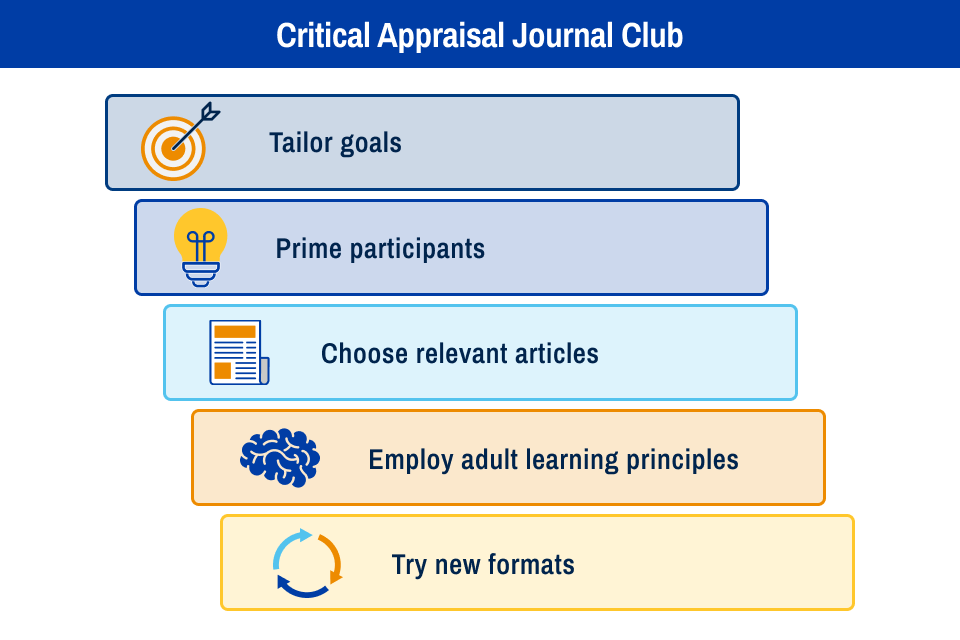
Adult learners differ from child learners in important ways, and these differences have direct implications for health professions education and critical appraisal. First, adult learners need to understand why they are being asked to learn something. Few experiences disengage learners faster than material that feels irrelevant. In the context of journal club, this means clearly stating your goals at the outset and explaining why a particular article matters to their work. While the importance of evidence appraisal may be obvious to some, others may benefit from explicitly connecting the process to how it may help provide improved, more nuanced patient care.
Adult learners also bring substantial prior experience to the learning environment, and new material must connect to their experience in practical ways. Selecting studies that reflect common clinical decisions faced by participants has the potential to help naturally increase engagement. A trial on diuretic dosing in heart failure will resonate more with internal medicine residents than one focused on surgical management of chronic rhinitis. In addition, introducing an article with a related clinical vignette can help anchor the discussion by illustrating how the study’s question arises in everyday clinical practice.
In addition, adult learners prefer some degree of autonomy in what and how they learn. In journal club, this can be achieved by encouraging active participation, inviting learners to suggest articles, and offering them the opportunity to facilitate sessions or influence the format. Sharing control over content and structure helps ensure that the session aligns with learners’ needs rather than feeling imposed. Moreover, learning is more effective when learners are intrinsically motivated. While intrinsic motivation cannot be forced, helping learners see the relevance of evidence appraisal to their own clinical growth can foster curiosity and deeper engagement over time.
Moderating Well
Beyond these learning principles, effective moderation plays a critical role in the success of a journal club. Making sessions interactive and enjoyable improves attention and participation, though this can be challenging in practice. There are several moderating strategies that can help avoid stagnation and keep the session engaging.
One useful strategy is to prime the audience by having them make a prediction. Like watching a sporting event, participants become more invested when they commit to an expectation. You may ask participants to predict a study’s results after a brief overview or ask participants to design their own version of the study before reviewing the paper. With these strategies, participants begin engaging in critical appraisal before encountering the authors’ decisions and findings. Comparing their predictions with the published study often sparks meaningful discussion.
Connecting unfamiliar research concepts to familiar clinical reasoning can also lower barriers to participation. Most participants will already understand that treatments carry risks and benefits, that patients differ in baseline risk, and that decisions require judgment rather than certainty. They also intuitively understand important appraisal concepts such as confounding or external validity, even if they cannot name them. Framing appraisal in clinical terms — or even using a SOAP-style structure to think through study questions, methods (subjective), results (objective) and application (assessment and plan) — can make abstract concepts more accessible.
Equally important is creating an environment where participants feel safe to contribute. Setting the expectation that there are no “wrong” answers, and reinforcing this through respectful responses can encourage discussion. While factual errors may require gentle correction, some of the most valuable conversations at journal clubs can arise during times of legitimate uncertainty. Acknowledging that multiple interpretations of the same evidence can coexist underscores why evidence appraisal is both necessary and intellectually rewarding.
Leading with humility further supports engagement. Evidence appraisal is challenging even for experienced clinicians, and moderators need not have all the answers. Openly acknowledging uncertainty models thoughtful skepticism and reinforces that participation does not require expertise. Enthusiasm also matters because when moderators visibly enjoy the process, that energy often becomes contagious.
Identifying Goals and Tailoring to Specific Learners
Clearly identifying and sharing goals with participants is another essential component of effective journal clubs. Goals might include teaching foundational appraisal concepts, reviewing landmark studies, discussing emerging evidence or exploring controversial trials. These aims should be tailored to the participant’s experience and comfort with critical appraisal, which can vary widely among students, residents and practicing clinicians. Aligning the goals of a journal club with the participants’ familiarity with evidence appraisal can help ensure that sessions are appropriately challenging without being overwhelming.
| Audience Familiarity with Critical Appraisal | Potential Goals |
|---|---|
| Limited |
|
| Moderate |
|
| Proficient |
|
Tailoring to Environment and Constraints
There is no one “gold standard” for how to run a journal club. A meta-analysis looked at research on successful journal clubs and found that they often have regularly scheduled meetings at reasonable times, clear purpose and incentives to encourage or mandate attendance. They also work best when a trained leader chooses papers and facilitates discussion, and they are most effective if participants review the paper in advance.
Best practices still need to be adapted to each journal club’s constraints. The traditional model — in which participants read the article beforehand and meet for discussion — can sometimes work well, but it assumes preparation time that faculty and trainees may not realistically have. Nontraditional formats can help address these limitations. To avoid requiring advance reading, you could try a “No-Prep Journal Club”, appraise sections of a study in pairs or small groups, or have a moderator present the methods and results while the audience engages in real-time appraisal. Debate-style journal clubs have also been used to increase engagement. Scheduling constraints can be eased by holding journal clubs during existing didactic time or including virtual attendance options. While no single format fits every setting, experimenting with different approaches can accommodate diverse learning needs and practical limitations.
Virtual journal clubs became more common during the COVID-19 pandemic. Benefits of this format include improved scheduling flexibility and option to record sessions. To promote success of virtual journal clubs, facilitators should plan for and oversee the technological aspects of the journal club and explain video conferencing etiquette in advance.
Conclusion
Returning to the clinic, you revisit the 68-year-old patient after moderating a journal club on the SPRINT trial. Your student now understands that more intensive blood pressure control may reduce cardiovascular risk, while also appreciating the limits of applying trial data to real-world patients. This balance — confidence tempered by thoughtful uncertainty — is precisely what evidence appraisal aims to cultivate.
Teaching critical appraisal and moderating engaging journal clubs is not easy. It requires intentional design, flexibility and ongoing reflection. By grounding sessions in adult learning principles, fostering psychological safety and remaining open to feedback and structural changes, educators can help learners develop both the skills and curiosity necessary to engage meaningfully with medical literature.

Adam Streicher, D.O. is assistant professor of internal medicine at SSM Health and the Saint Louis University School of Medicine. His areas of professional interest include critical appraisal, curriculum development and teaching strategies. Streicher can be contacted via email.