Required Clerkships
Each of your seven core clerkships provides an immersive clinical experience, strengthening your skills and preparing you to function as an active, valued member of a patient care team.
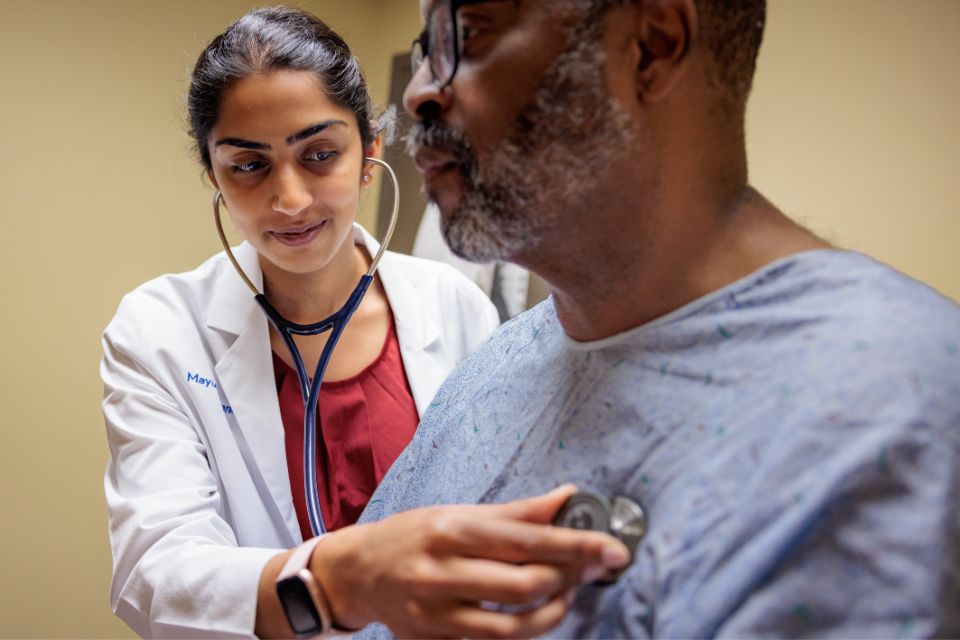
Your specific clerkship order is determined by a student lottery. To ensure your seamless transition into the clinical environment, your year will begin with a one-week introduction to core clerkships. For each individual rotation, you’ll attend a one-day orientation and work with an education coordinator who manages schedules, performance evaluations and administrative issues.
Explore Your Clerkships
Train with family medicine physicians in a variety of clinical settings to explore career paths tailored to your preferences.
Features
- Establish a comprehensive, holistic approach to patient care.
- Develop lasting, caring relationships with patients and their families.
- Integrate the biological, clinical and behavioral sciences into daily practice.
- Help diagnose and treat patients of all ages.
- Spend four days per week in an ambulatory care setting.
- Engage in one dedicated on-campus day of didactic sessions.
- Learn from faculty, residents and preceptors.
Training Environments
Function as an integral component of an inpatient medical team alongside an attending physician, residents and peers. There is no overnight call.
Features
- Master clinical decision-making, diagnostics and therapeutics.
- Obtain comprehensive patient histories.
- Perform detailed physical examinations.
- Identify problems based on historical and physical exam findings.
- Formulate accurate diagnoses and treatment plans.
- Deliver concise, organized oral case presentations.
- Establish a self-directed reading program to strengthen your knowledge base.
- Attend weekly sessions covering evidence-based medicine and complex problem-solving.
- Complete both a written and online examination at the end of the clerkship.
Training Environments
Work on a neurology team alongside an attending physician, neurology and rotating residents, and medical students. Manage your own inpatients and take in-house calls on two evenings and one weekend.
Features
- Obtain comprehensive patient histories.
- Perform general and neurological physical examinations.
- Formulate a tentative diagnosis by localizing pathologies within the nervous system.
- Leverage laboratory support to verify your tentative diagnosis.
- Gain familiarity with neuroimaging and electrophysiological procedures.
- Attend rounds six days per week, with one weekend day free.
- Present initial findings and daily developments to your attending physician.
- Coordinate discharge plans, therapeutic maneuvers and follow-up care.
- Engage in thrice-weekly didactic sessions on principal neurological diseases.
- Complete weekly quizzes and a final written examination.
Training Environments
Gain comprehensive training across obstetrics, gynecological surgery, primary preventative medicine, and psychiatric and psychological problems in women’s healthcare.
Features
- Complete two-week training blocks.
- Complete one weekend day of call on the labor and delivery unit.
- Attend a weekly half-day outpatient clinic.
- Work with high-risk maternal-fetal medicine attendings.
- Treat patients in the triage and active delivery units.
- Engage in one dedicated weekly morning of didactic sessions.
- Attend Grand Rounds on Fridays.
- Utilize institutional databases, programs and references to supplement your learning.
- Complete ongoing quizzes, a summative OSCE and the NBME exam.
Training Environments
- SSM Health St. Mary’s Hospital – St. Louis
Explore the Department of Obstetrics, Gynecology and Women’s Health
Learn the general aspects of growth, development, physical and mental health, and pediatric illnesses. You'll have inpatient, ambulatory and neonatal clinical experiences.
Features
- Treat a variety of common and complex illnesses.
- Identify patterns of growth and development.
- Obtain comprehensive patient histories.
- Learn physical and neurological examination techniques.
- Evaluate and manage common pediatric disease processes and determine expected outcomes.
- Complete four weeks of inpatient clinical training (one weekend day off) and four weeks of ambulatory clinical training (no weekend duty).
- Attend half-day outpatient subspecialty clinics.
- Complete five days attending cesarean sections and treating newborns.
- Attend regular faculty lectures and weekly Grand Rounds.
- Submit two written admission histories and physicals for critique.
- Complete regular quizzes and the NBME examination.
Training Environments
Treat adult, geriatric and veteran patients experiencing psychiatric conditions and complications. Work in inpatient and outpatient settings. Weekend duties vary.
Features
- Work on a team serving the entire hospital, including emergency and transplant departments.
- Evaluate psychiatric disorders and treatments.
- Develop effective communication skills.
- Understand personality development from childhood through adulthood.
- Access asynchronous online lecture modules.
- Visit specialty sites and attend optional learning activities.
- Complete focused reading and the NBME exam.
Training Environments
Explore the Department of Psychiatry and Behavioral Neuroscience
Function as an active surgical team member, primarily focusing on general surgery — an essential foundation for all medical fields.
Features
- Provide active, hands-on patient care.
- Manage clinical evaluation, diagnosis, treatment and follow-up.
- Evaluate patients across pre- and post-operative stages.
- Determine indications and risks for a range of common surgical procedures.
- Master sterile technique in minor procedures and within the operating room.
- Acquire basic suturing, wound closure and wound management skills.
- Accompany surgical teams into active operations.
- Attend morning rounds and scheduled teaching conferences.