Russian
Saint Louis University’s program in Russian studies seeks to develop in our students an enthusiasm for pursuing knowledge of Russian language, literature, culture, history and political science.
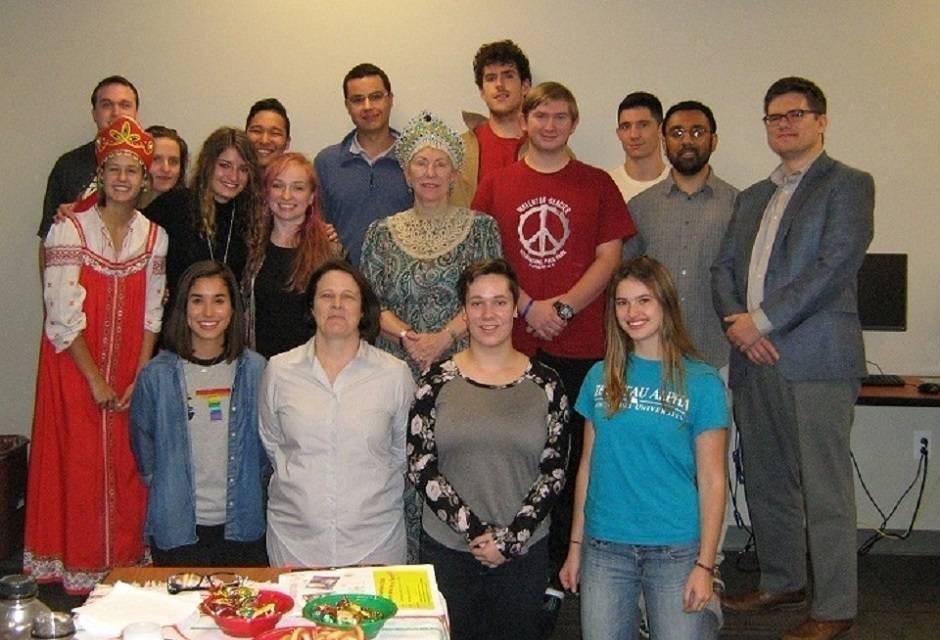
Saint Louis University’s program in Russian Studies for more than fifty years has been supporting students’ study of Russian language and culture. Currently, students can expect a communicative approach to language learning that balances accuracy with fluidity in approximations of immersive contexts with authentic learning materials and digital technologies.
With programs in Russian Studies, Russian Area Studies, and International Studies, students can explore their interest in Russian language and culture in courses on cinema, digital studies, drama, fine and performing arts, history, political science, theology, and philosophy. Independent studies allow Russian minors to focus on personal research interests in preparation for graduate and professional studies.
Recent program activities have included the Central Slavic Conference, roundtable discussions on political issues, student presentations on study abroad, Russian trivia competitions, and faculty presentations on applying for undergraduate funding opportunities for study abroad (e.g., Critical Language, Boren, and Fulbright programs). The coordinator of the Russian Program, Dr. Elizabeth Blake has been trained to read applications for NSLI-Y (National Security Initiative for Youth) and has received US Department of Education and US Department of State grants for her own research and pedagogical training. Information about the study abroad program may be found here.
For more information about related professional opportunities in Russian, please see Why study Russian? by American Council of Teachers of Russian or visit Dr. Blake’s site. If you have already begun studying Russian, the program accepts AP placement through NEWL and admitted students can take an online placement exam
Coordinator: Elizabeth Blake, Ph.D.
Russian Club
The Russian Club has existed since the 1950s when Russian achievements in air-space explorations boosted interest in Russian. The club was one of the few available sources of knowledge and experience of Russian traditions and lifestyle.
Meetings are held twice a semester, focusing on traditional Russian festivals or a selected topic. Students get hands-on experience making traditional Russian dishes and acquire a taste for genuine Russian food (i.e. borsh, pirozhki, bliny, golubtsy, sushki, prianiki, Russian salad) and drink (e.g. kvas, tea with lemon). On special occasions, Russian club members take field trips to the annual Russian Festival, the Russian Orthodox Church or local Russian restaurants Dvin and Zhivago's.
Student Profile
Jake Bernstein
Hometown: Millstadt, Illinois
Majors: Computer Science and Russian Studies
Favorite Russian Class: Fluency in Russian
Career Interests: Web Development, Web Design, Cybersecurity
Research Interests: Soviet Rock Music Counterculture
Favorite Part of the Russian Program: Russian Club
Здравствуйте! I’m Jake, a senior majoring in computer science and Russian studies. I’m a SLU Russian Club member and a passionate advocate for the SLU Russian program. I became interested in Russia when I was still in high school, where I became close friends with several exchange students from Russia, Eastern Europe and Central Asia. I decided to pursue Russian academically when I came to SLU, and I fell absolutely in love with the language and culture. In spring of 2018, I studied abroad in St. Petersburg as part of the Bard-Smolny program. I enjoyed my time there immensely, and I strongly encourage everyone to visit — even those who don’t speak Russian.
In the future, I hope to combine my knowledge of computers and network technology with my language and cultural experiences in my career. What exactly will I be doing in 10 years? I couldn’t say, but I hope the combination of language and technology skills will open some doors for me, and for anyone else who decides to combine a STEM degree with a foreign language. As an aside, languages are not limited simply to those who are pursuing international business, political science, diplomacy, or a related field. They are useful for hard science and engineering, as well!