Supporting Trainees Through Clinical Uncertainty
Clinical uncertainty is pervasive in the practice of medicine and a fundamental aspect of medical education. Some argue that one of the most important shifts needed in modern medicine is learning to recognize, tolerate and effectively manage uncertainty, rather than pursuing diagnostic certainty at all costs. Reflecting its importance, the Accreditation Council for Graduate Medical Education (ACGME) lists the ability to acknowledge limitations in one’s knowledge and expertise as a core competency for resident physicians. Yet while uncertainty is common, with clinicians verbally expressing it in 71% of patient visits, there is little guidance on how to navigate it effectively or teach others to do so. This gap has meaningful consequences, as distress related to uncertainty is associated with depression, burnout and lower job satisfaction, particularly among trainees. As clinician-educators, we have a responsibility not only to teach medicine but also to help trainees navigate the uncertainty that accompanies it. Several practical steps can be taken to better prepare learners to thrive in the space between certainty and doubt.
Create a Culture That Accepts Uncertainty
A foundational step in teaching medical trainees to navigate uncertainty is accepting it within the learning environment. Clinician-educators can play a powerful role in shaping this culture through how they speak about and respond to ambiguity in clinical practice. When clinician-educators openly acknowledge uncertainty, they model an important aspect of medical practice. Doing so signals to trainees that not always having the answers is an expected part of both medical training and patient care, rather than a sign of incompetence. Over time, consistent role-modeling can promote psychological safety, allowing trainees to feel more confident voicing uncertainty, asking questions and engaging in diagnostic reasoning without fear of judgment.
Cultivate the Use of Curiosity
Clinician-educators can create a learning environment that emphasizes inquiry-driven learning rather than answer-focused instruction. By encouraging learners to ask questions such as how and why, educators promote critical reflection and a deeper engagement with the reasoning underlying clinical decisions. Encouraging learners to explore their reasoning, consider alternative explanations and reflect on gaps in their understanding helps normalize uncertainty. By doing this, trainees are recognized not only for what they know, but also for their willingness to ask thoughtful questions, challenge assumptions and engage in intellectual exploration. Over time, curiosity can evolve from a trait into a habit of mind – one that can promote critical thinking, lifelong learning and more thoughtful engagement with complex clinical problems.
Model How to Communicate Uncertainty With Patients
Modeling how to communicate uncertainty with patients is an essential responsibility of clinician-educators. Clinician-educators can demonstrate how to acknowledge uncertainty while maintaining confidence, empathy and professionalism. This includes clearly explaining what is known, what remains uncertain and the rationale for the proposed plan of care. Rather than viewing uncertainty as a weakness, trainees should learn to frame it as an expected part of complex clinical decision-making. During patient encounters marked by uncertainty, clinician-educators can exemplify professional humility by responding, “I don’t know, but I will find out.” When delivered thoughtfully, these moments teach trainees that transparent communication fosters trust and can strengthen the therapeutic relationship between clinicians and patients.
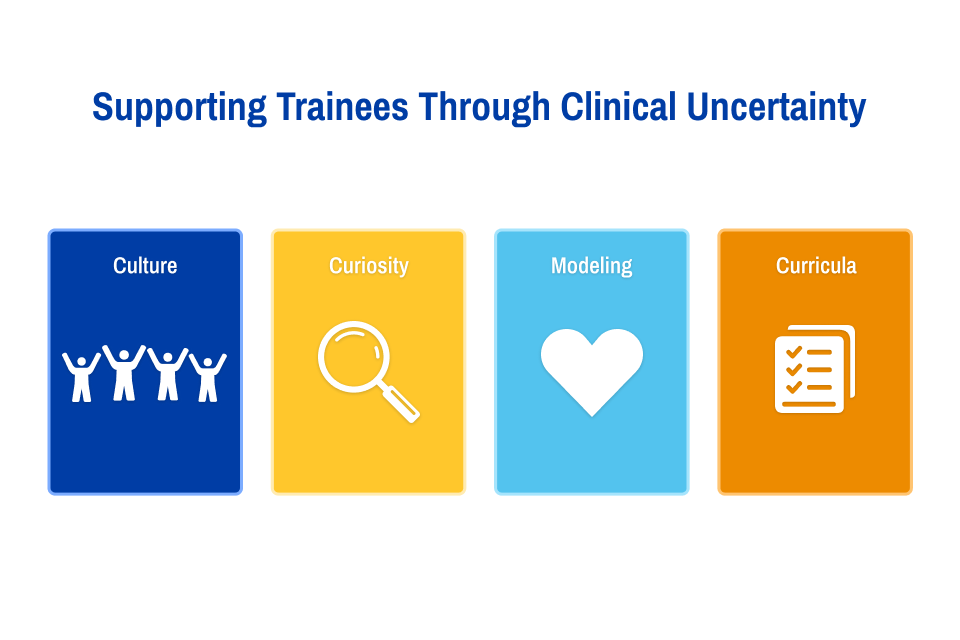
Design Curricula to Model Real-World Care
Uncertainty should not be encountered for the first time on the medical wards; rather, it should be intentionally integrated throughout undergraduate medical education. Opportunities to engage with ambiguity can be woven into curricula through reflective writing, problem-based learning, and simulation exercises with structured clinical debriefings. By systematically incorporating uncertainty into medical training, clinician-educators reinforce that managing ambiguity is not a peripheral skill but a core competency in the practice of medicine.
As clinician-educators, our responsibility extends beyond teaching medical knowledge and clinical skills; we must also help trainees develop the confidence needed to navigate the uncertainty inherent in clinical practice. This begins with fostering learning environments that normalize the recognition of uncertainty, encourage intellectual curiosity and promote thoughtful inquiry. We can further support trainees by modeling transparent and effective communication of uncertainty with patients. Finally, medical schools should consider intentionally incorporating discussions of uncertainty throughout the curriculum using a variety of educational approaches to help ensure that learners are equipped not only to manage ambiguity but also to thrive within it.

Ashley Noonan, M.D., is a chief resident in the SSM Health/Saint Louis University School of Medicine Internal Medicine Residency Program. Noonan's areas of professional interest include belonging, curriculum development and gamification in medical education. Noonan can be followed on LinkedIn.