Aerospace and Aviation Research
Saint Louis University has always been on the frontlines of the aerospace industry, with a rich history in the field tracing back to the founding of the Oliver L. Parks Department of Aviation Science, which holds the title of the first federally approved school of aeronautics.
In the years since, our commitment to aerospace research has only grown. And now, our aerospace ties go even farther. We’re exploring aviation safety, spacecraft technology and more.
Research Projects
Assessing a Pilot’s Experience During Inflight Emergencies
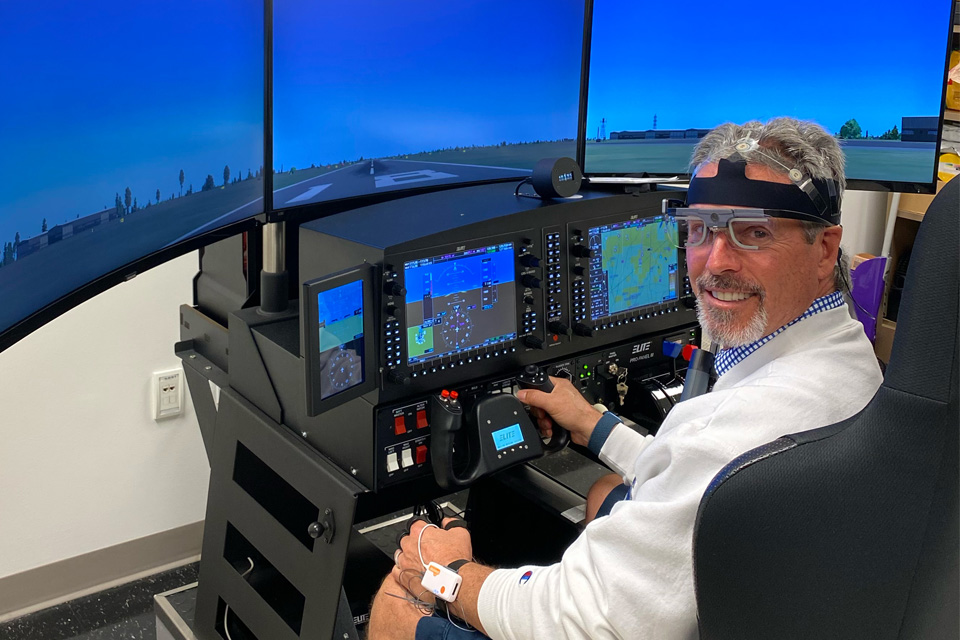
As a pilot, safety isn't just a consideration; it’s a top priority. A better understanding of the hazards involved with flight and how to mitigate risks is key to improving the aviation industry, both for pilots and passengers.
The Aviation Learning, Education and Performance (AVLEAP) Lab, led by Gajapriya Tamilselvan, Ph.D., evaluates pilots' cognitive workload, decision-making skills and related human factors during inflight emergencies by assessing their physiological, psychological and behavioral characteristics.
The AVLEAP Lab investigates the psychophysiological processes that influence how pilots think, manage workload, decide, and operate in the cockpit. Through studies on aviation physiology and human factors, aeronautical decision-making and aviation safety, the lab aims to improve the way we fly.
Technology for Safer Airport Runways
In Luigi Dy, Ph.D.'s lab, researchers are on a mission to make airport runways safer. The team is working to develop an affordable runway status light system, similar to railroad crossing lights, that can mitigate the risk of collisions on the runway. With the St. Louis Downtown Airport serving as a real-world local laboratory for the team, researchers hope to bring this safety system to airports across the country.
Building Spacecrafts
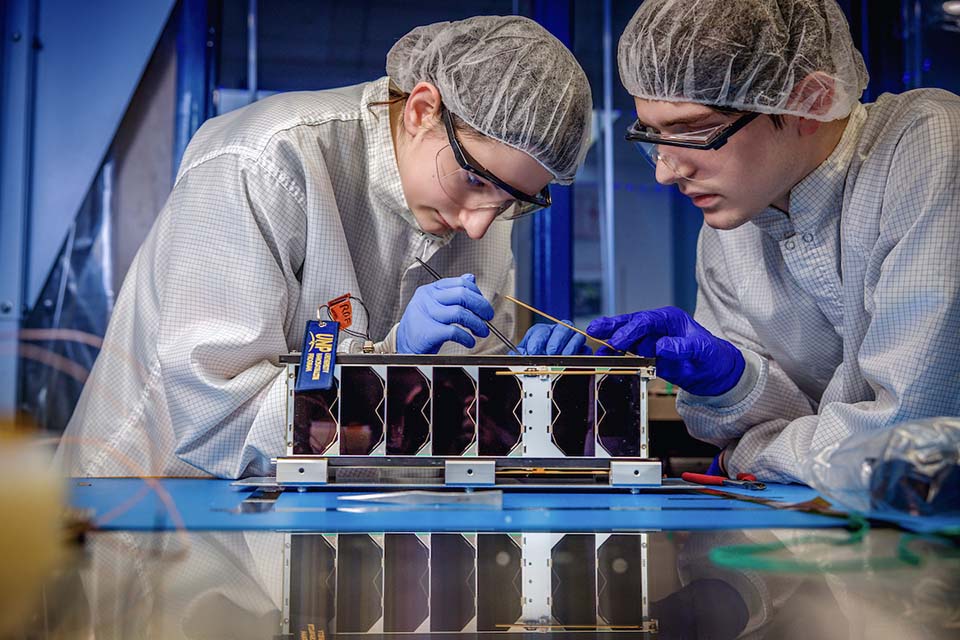
In the Space Systems Research Laboratory, led by aerospace and mechanical engineering professor, Michael Swartwout, Ph.D., faculty and students are performing world-class research in the design, fabrication and operation of space systems. Currently, researchers in the lab are progressing through the entire space-mission life cycle on three missions, including requirements, design, analysis, assembly, test and flight operations.
Modern electronics and modern delivery systems have enabled the use of very small spacecraft to achieve important science, exploration and technology demonstration missions. However, these new kinds of spacecraft face new obstacles to achieving mission success. In the production of these three spacecraft, faculty and students are focusing research efforts on mission assurance of small spacecraft, development of new components for small spacecraft and flight experiments in spacecraft autonomy.
An Emphasis on Space Safety: Avoiding Satellite Collisions
As thousands of low-Earth-orbit satellites are launched each year, and with an increased interest in human space travel and tourism, the risk of space accidents is on the rise. These accidents can occur between two satellites, between a spacecraft and a satellite, or even between a satellite and debris. In fact, several such accidents have already happened.
In the SLU-PNT Lab, led by associate professor Jian Yao, Ph.D., of the Department of Earth, Environmental and Geospatial Science, researchers are working to precisely predict the trajectories of these space objects to avoid collisions. With increased safety in mind, the group aims to improve the prediction of near-Earth satellite orbits under a wide range of circumstances.