Geospatial, Environmental and Sustainability Research
The future of our physical world depends on the discoveries we make today, discoveries that students and faculty in the School of Science and Engineering at Saint Louis University are actively working toward with research focused on environmental problems, geospatial questions and sustainability solutions.
Research Projects
Improving Agriculture with “Digital Twin” Modeling
Funded by a $1.2 million award from the National Science Foundation, researchers from
the School of Science and Engineering and the SLU School of Medicine are working to develop AI “digital twin” models of agriculture fields. The goal of
the models is to better analyze the plants, their environments, and their genetics,
which has the potential to improve crop output and create better-quality plants.
Faculty researchers include computer science faculty members Abby Stylianou, Ph.D., David Letscher, Ph.D., and Flavio Esposito, Ph.D., aerospace and mechanical engineering faculty member Madi Dian, Ph.D., and Maureen Donlin, Ph.D., a faculty member in the SLU School of Medicine.
Advancing Food Security, Resilience and a Sustainable Planet with AI
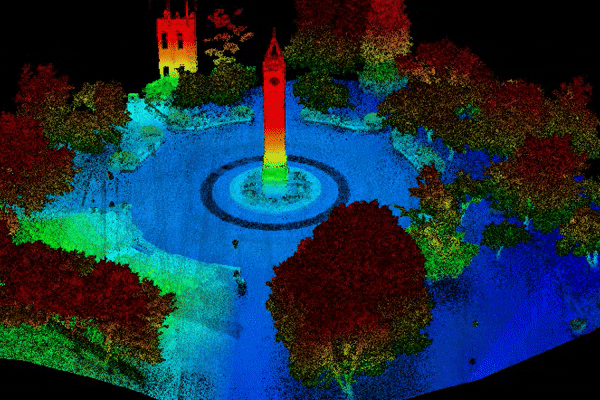
Using innovative technologies including geospatial computer vision, digital twins, remote sensing, and sensor fusion, the Remote Sensing Lab at Saint Louis University, led by professor Vasit Sagan, Ph.D., is tackling the planet's most pressing challenges. From boosting crop productivity and detecting disease before it spreads, to monitoring drought, land deformation and ecosystem change at a global scale, researchers in the lab fuse satellite, drone and hyperspectral data with advanced AI to see what the naked eye cannot — and act before disaster strikes.
Learn More About the Remote Sensing Lab
Contributing to GPS Modernization
Research from the SLU-PNT Lab, led by associate professor Jian Yao, Ph.D., of the Department of Earth, Environmental and Geospatial Science, is exploring how one of the world's most important systems can be updated to meet today’s challenges. The Global Positioning System Control Segment monitors satellite orbits, clocks and health to provide reliable positioning, navigation and timing services worldwide. However, the current ground-based monitoring architecture, designed decades ago, faces growing challenges amid rising threats from system faults, jamming and spoofing.
Researchers in the lab are exploring the feasibility of a ground-space hybrid GPS monitoring system that integrates low-Earth-orbit satellites as space-based monitor stations, with the goal of improving these increasingly important systems. Researchers in the lab are also focused on estimating satellite clock offsets, including those of newly launched satellites, for the National Geodetic Survey and evaluating how atomic clocks at ground stations contribute to improved monitoring of the GPS system. In addition, researchers are exploring novel remote-sensing applications of Global Navigation Satellite System signals, such as detecting coseismic ionospheric disturbances.
Learn More About the SLU-PNT Lab