Research Centers, Programs and Labs
Students and faculty in SLU's School of Science and Engineering are involved in dozens of research centers, programs and labs across departments as they work to solve problems, innovate and make the world a better place.
Spaces dedicated to science, engineering and aviation research efforts are found in buildings throughout campus, including the Sinquefield Science and Engineering Center, which houses faculty research labs, interdisciplinary research groups, centers and more. Many of the school’s research labs welcome undergraduates and graduates as collaborators in their research efforts, giving students hands-on opportunities throughout the college journey.
Where will your next great research idea take shape?
SSE Research Centers, Programs and Institutes
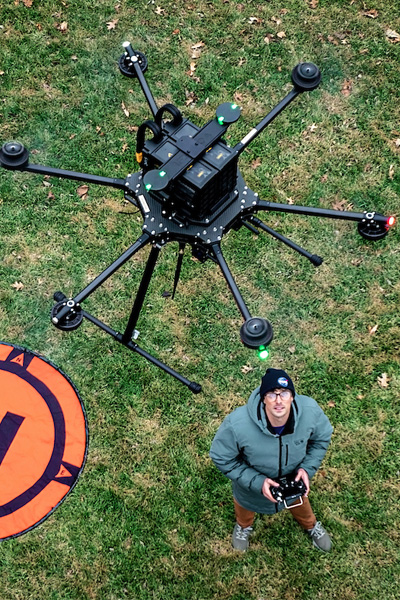
Geospatial Center at Saint Louis University
The Geospatial Center at SLU connects researchers across the University to collaborate on geospatial research on topics like agriculture, national security, quantum sensing and more.
Open Source with SLU
As SLU's open-source program office, Open Source with SLU connects students with real-world software development projects while preparing workforce-ready graduates.
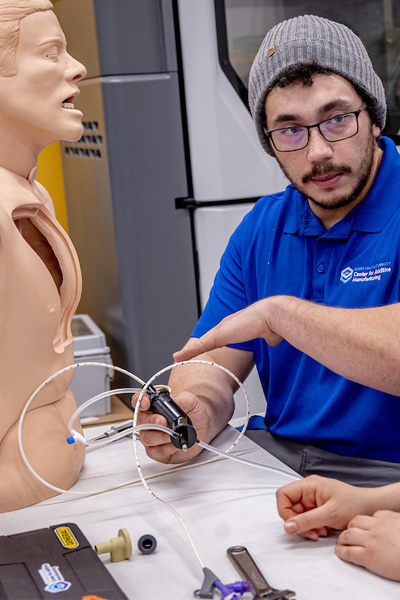
SLU Center for Additive Manufacturing (SLU-CAM)
SLU-CAM is a resource for 3D printing, computer-aided design and related activities, available to faculty, students and the community.
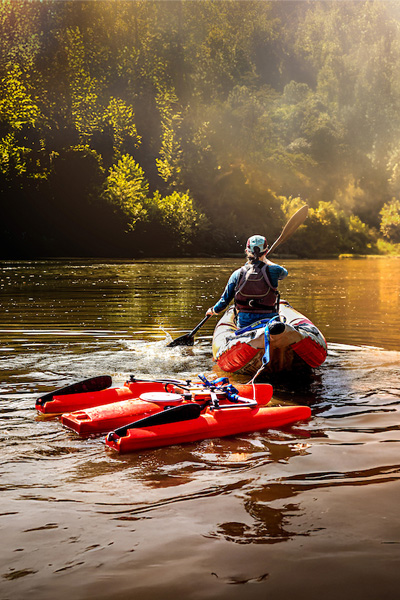
The WATER Institute
Researchers at the Water Access, Technology, Environment and Resources (WATER) Institute at Saint Louis University conduct interdisciplinary research that addresses critical water resource challenges while strengthening existing efforts across the University.
SSE Faculty Research Labs
Faculty throughout the School of Science and Engineering are performing innovative research with real-world impact. Explore the research labs led by SSE faculty members, where both undergraduate and graduate students have opportunities to get involved in cutting-edge work.
Department of Aerospace and Mechanical Engineering
The Collaborative Haptics, Robotics and Mechatronics (CHROME) Lab at Saint Louis University is reimagining technology through touch. Researchers in the lab design inclusive, multisensory technologies — from wearable haptics and accessible touchscreens to tangible learning tools — working with communities to create technologies that help people learn, heal and connect.
The Mecharithm Lab conducts research at the intersection of mechatronics, artificial intelligence and human-robot interaction to build physical AI systems for human-robot teaming. Our work focuses on decoding multi-modal human intent such as verbal commands, visual cues, physical signals, grounding language and vision into real-time robot actions for different robotic systems.
MOSAIX (Multiscale mOdeling, Simulation & Integrated eXperimentation) Lab is focused in advancing the design and understanding of next-generation materials through the integration of multiscale modeling, simulations and experimental framework. By bridging advanced computational simulation and state-of-the-art experimental characterization techniques, the lab aims to investigate the multifunctionality of materials towards enhanced durability and sustainability primarily in aerospace applications.
The Space Systems Research Laboratory develops navigation methods and autonomous operations models for space missions and applies these ideas as experiments on small spacecraft that undergraduate students design, build and operate.
Oliver L. Parks Department of Aviation Science
The Aviation Learning, Education, and Performance Lab (AVLEAP) evaluates pilots' cognitive workload, decision-making skills, and related human factors during inflight emergencies by assessing their physiological, psychological, and behavioral characteristics. The lab conducts studies on aviation physiology and human factors, aeronautical decision-making, and aviation safety, as well as pilots' selection, training, and retention in commercial aviation.
Department of Biomedical Engineering
Gai's Neuroengineering Lab is dedicated to the cutting-edge technology of human-machine interface, intelligent prosthetics, and deep-learning neural networks. The lab's recent projects include smart spatial hearing aids, brain-computer interface and robotics sensory augmentation.
Primarily focusing on tendon and muscle, the Musculoskeletal Biomechanics Lab seeks to understand healthy tissue function and structure, assess changes that occur in injury or disease, and provide guidelines for improved treatment strategies. The lab uses a diverse set of techniques from wearable sensors in humans to preclinical animal model testing.
The Musculoskeletal Tissue Engineering Lab focuses on the repair and rehabilitation of injured musculoskeletal tissues following trauma. The goal of the research is to bioengineer materials and stem cells and integrate them with novel rehabilitation strategies to maximize the recovery of injured tissues.
The Zustiak Lab develops hydrogel biomaterials for soft tissue engineering and drug delivery. The group designs and characterizes polymer networks with tunable mechanical, biochemical, and degradation properties, applying a range of physicochemical and biological assays to evaluate material performance.
Department of Chemistry
Research in the Baum Lab focuses on identifying new activities for DNA and RNA sequences known as aptamers, ribozymes and DNAzymes, and using these functional nucleic acids in studies in the areas of chemical biology, biochemistry, analytical chemistry, and others.
From the building blocks of nature to disease-battling therapeutics and vaccines, carbohydrates have had a profound impact on evolution, society, economy and human health. With the participation of more than 180 co-workers/trainees, the Demchenko laboratory (Glycoworld) has been developing innovative tools for the synthesis and application of carbohydrates.
The Martin Group uses 3D printing technology to create microfluidic organ-on-a-chip devices to study cell-to-cell communication with integrated analytical schemes.
The McCulla Lab focuses on using light-driven chemical reactions and reactive oxygen and nitrogen species to control, probe, and understand biological and organic chemical processes. This research combines photochemistry, redox chemistry and computational studies to investigate how reactive intermediates interact with molecules such as enzymes, DNA and thiols, with applications ranging from catalysis to biological oxidation mechanisms.
Research in the Meyers Lab is focused on discovering novel drug candidates to improve and save the lives of people with rare and neglected diseases with a particular focus on infectious diseases. Guided by medicinal chemistry and structure-based drug design principles, researchers use synthetic organic chemistry to synthesize new molecules for testing as potential antiparasitics, antibacterials, antifungals, antivirals and rare disease therapeutics.
Department of Civil Engineering
The Geomaterials Research Lab explores subsurface characterization, multiscale and multiphysics geomaterial behavior, advanced imaging of heterogenous materials, physical and reduced scale modeling of geosystems under, various environmental conditions and geospatial science for cold regions.
The Li Lab lab develops AI-driven methods to understand, model and control intelligent transportation systems. The research focuses on automated and connected vehicles, traffic dynamics, transportation safety and cybersecurity, with the goal of enabling safer, smarter and more sustainable mobility.
The Sustainable Engineering Lab engineers symbiotic relationships between algae, bacteria and fungi to transform wastewater, stormwater, and other waste streams into valuable resources, including nutrients, energy and bio-based chemicals. By combining microbial encapsulation, electrochemical systems, and biological engineering, researchers create innovative bioreactors that turn waste into opportunities for a more sustainable, circular economy.
Department of Computer Science
AIRLab develops artificial intelligence and computer-vision technologies that connect digital intelligence with the physical world. Its research spans physical AI and multimodal perception, geospatial AI and robotic sensing by integrating advanced sensing, machine learning, geometric vision and physical experimentation.
The BioHPC Lab works at the intersection of artificial intelligence, bioinformatics/biomedical informatics, and high-performance computing (HPC). Much of the work focuses on developing AI and computational methods to analyze very large, complex scientific and biomedical datasets.
The GXR Lab advances research at the intersection of artificial intelligence, physically based simulation, and extended reality (VR/AR). Its work develops learning methods grounded in physical behavior: models that capture how real materials deform, how exhaled airflow moves and how individual people acquire physical skills, embedded in interactive systems that respond in real time.
Researchers in the Multimodal AI Lab study computer vision and multimodal machine learning, with a focus on image retrieval, explainable AI, and applications for humanity, social good and science.
Faculty Contact: Abby Stylianou, Ph.D.
Research in the Wireless Networks and Intelligent Systems Lab focuses on integrating AI with next-generation wireless communication, sensing, and networking systems, including AI-enabled underwater networking, AI-enabled optical communication and sensing, AI for wireless sensing, and AI for network automation. The goal of the research is to make future wireless systems more intelligent and autonomous.
Department of Earth, Environmental and Geospatial Science
The Remote Sensing Lab advances geospatial science through machine learning and AI–driven analysis of multi-scale remote sensing data to tackle pressing challenges in agriculture, environmental change, and socio-ecological resilience.
The SLU PNT Group focuses on topics such as Positioning, Navigation and Timing (PNT), Global Navigation Satellite System (GNSS), Orbit Determination and its applications in remote sensing and geodesy, and time and frequency metrology.
Department of Electrical and Computer Engineering
In the Complex Photonics Lab, researchers are exploring non-Hermitian and topological photonics, quantum optics, nonlinear photonics, micro and nano lasers, and computational electromagnetics. They aim to innovate new methods and techniques to control light generation, flow, trapping and its interaction with matter for applications in quantum technologies, biomedical, sensing and communications.
KLab Photonics Lab focuses on studying the interaction of light in time-varying materials and studying the interaction of the environment on the properties of quantum emitters.
The NanoFrontiers lab bridges physics, materials science, chemistry and mechanics of engineered interfaces to research novel approaches for design and characterization of 1D and 2D nanomaterials. Research approaches include the controlled synthesis and fabrication of atomically thin 2D nanomaterials, van der Waals heterostructures and 1D nanowires and carbon nanotubes.