Artificial Intelligence Research
At the Saint Louis University School of Science and Engineering, we’re on the frontlines of artificial intelligence research, as we examine the role AI will play in the future of our society, both positive and negative.
As a Jesuit institution, we take a mission-driven approach to the artificial intelligence industry, answering the questions of how artificial intelligence can be used for the support of humanity. We’re not afraid of asking the hard questions when it comes to artificial intelligence while also embracing the potential artificial intelligence has to change lives for the better.
Research Projects
Faculty and students are working together on projects throughout the School of Science and Engineering that explore the use of artificial intelligence. Research in artificial intelligence crosses traditional disciplines with SSE faculty exploring the role of artificial intelligence in the environmental, robotics and aerospace fields.
Learn more about some of these innovative projects.
Going Underwater with AI
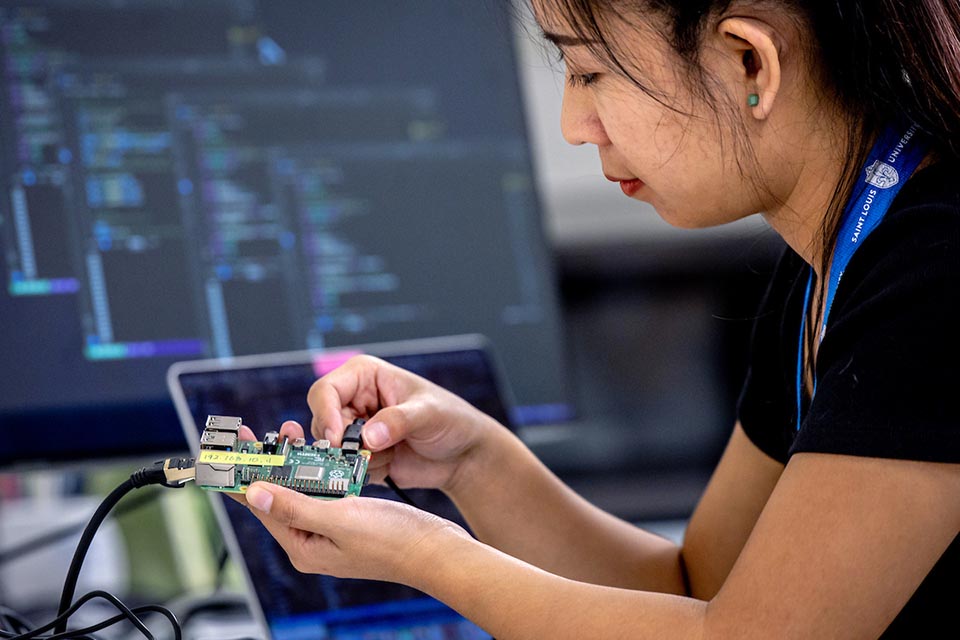
The Wireless Networks and Intelligent Systems (WNIS) Lab, led by Nan Cen, Ph.D., is working to make wireless networks more intelligent and autonomous, with research focused, in part, on intelligent underwater networks. By integrating optical, acoustic and magnetic communication, along with AI and digital-twin technologies, researchers in the lab hope to make networks that go beyond the transmission of information. With the use of advanced technology like optical wireless communication systems, software-defined radios and underwater communication testbeds, the team is able to combine AI algorithms with real wireless hardware.
Using AI to Combat Human Trafficking
Planning your next trip? Sharing a photo of your hotel room could help change a life, thanks to an app developed by computer science professor Abby Stylianou, Ph.D., and a team of researchers. Using artificial intelligence and machine learning, TraffickCam helps combat child sex abuse and human trafficking by using crowd-sourced photos of hotel rooms to identify where photos of criminal activities were taken. This helps investigators find victims and prosecute perpetrators.
Using AI systems, the research team is creating models and user interfaces that better enable analysts to align their search results with their expertise and intent, bridging investigations with evidence more efficiently.
Changing How We Learn
In computer science professor Min Choi, Ph.D,’s GXR Lab, researchers are exploring how AI, virtual reality, and extended‑reality technologies can accelerate the acquisition of fine‑motor skills—from refining a golf swing to relearning precise movements after a stroke.
When learning or relearning a skill, individuals often lack access to specialized facilities, equipment or personalized guidance. Without that support, translating intention into controlled, accurate movement becomes significantly more challenging. The lab’s research aims to bridge this gap by integrating AI‑driven coaching with immersive VR/XR environments that provide real‑time motion guidance. These adaptive systems allow learners to explore, practice and fine‑tune movements safely and repeatedly, helping them build precision, confidence and skill more efficiently.
Transforming Large-Scale Environments into Manageable Data with AI
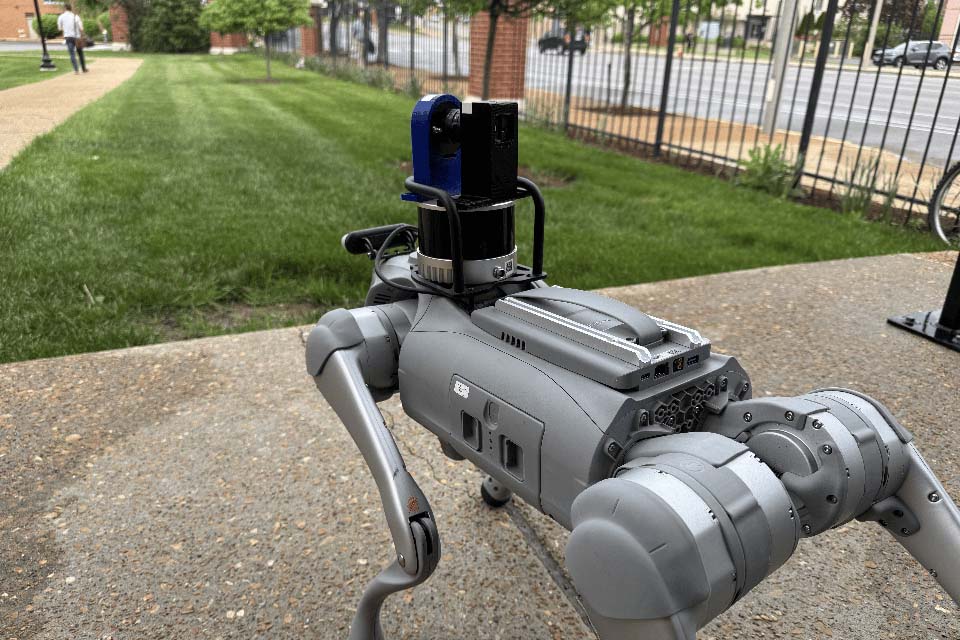
The AIRLab, led by Hadi Akbarpour, Ph.D., develops AI and computer-vision methods for understanding large-scale environments from aerial and multimodal sensor data. The goal is to transform large volumes of imagery and sensor measurements into useful 3D representations that can support mapping, situational awareness, environmental understanding and autonomous systems. In collaboration with both geospatial and aerospace researchers in the SSE, the impact of the work goes beyond disciplines.
Improving Automated Cars with AI
Artificial intelligence isn’t just changing our digital world. In the Li Lab for Intelligent Transportation Systems, led by civil engineering assistant professor Tianyi Li, Ph.D., researchers are exploring AI-powered methods to make future transportation systems safer and more efficient. The team is developing AI-based models to understand and control automated and electric vehicle behavior with the goals of designing automated vehicles that can interact more naturally and safely with human drivers, improving cybersecurity in the vehicles and determining how the vehicles affect traffic flow.
Understanding Complex Biological and Biomedical Data with AI
Researchers in the BioHPC Lab, led by computer science associate professor Ted Ahn, Ph.D., are developing artificial intelligence and bioinformatics methods to uncover meaningful patterns in large-scale biological and biomedical datasets. The lab applies AI, machine learning and high-performance computing to genomic, microbiome, single-cell and other multi-omics data, with the goal of identifying molecular and cellular patterns associated with disease and improving our understanding of complex biological systems.
Learn More About the BioHPC Lab
Artificial Intelligence Academic Programs
- Artificial Intelligence Literacy, Microcredential
- Artificial Intelligence, M.S.
- Computer Science, B.A. to Artificial Intelligence, M.S. Accelerated Program
- Computer Science, Minor to Artificial Intelligence, M.S. Accelerated Program
- Data Science, B.S. to Artificial Intelligence, M.S. Accelerated Program