Robotics and Sensors Research
Researchers in the School of Science and Engineering at Saint Louis University are creating a future where humans and robots work seamlessly together, improving the way we live. From machines that change remote work to systems that make the world more accessible, the future of technology is becoming a reality in labs across campus.
Research Projects
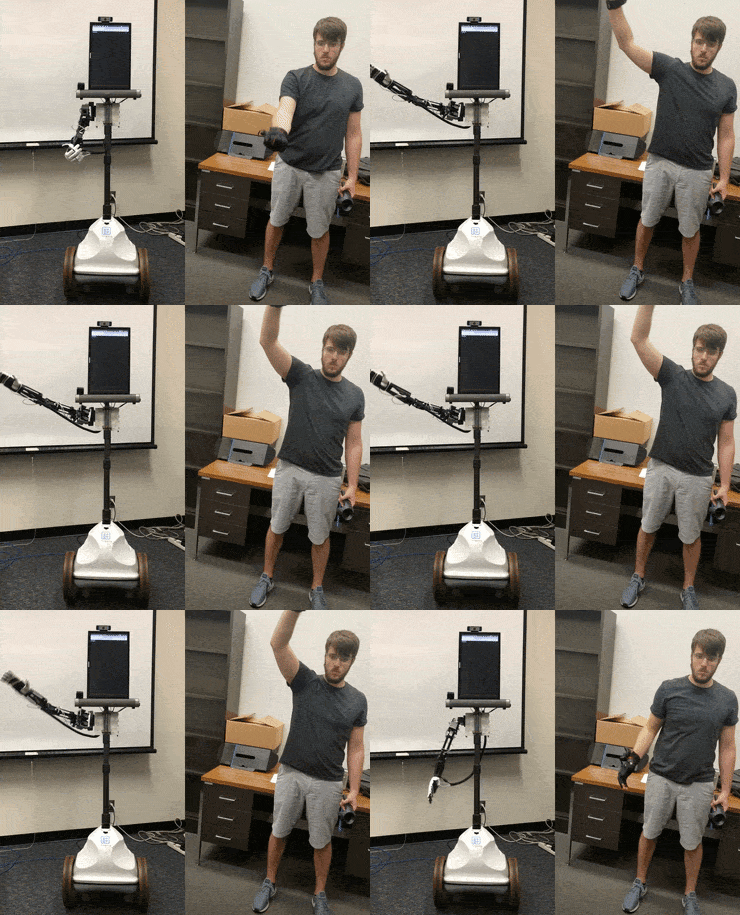
Enhancing Remote Communication with Robotics
The Collaborative Haptics, Robotics and Mechatronics (CHROME) Lab, led by Jenna Gorlewicz, Ph.D., chair of the Department of Aerospace and Mechanical Engineering, includes a team of undergraduate and graduate researchers focused on bridging novel technical advancement with societal impact through projects that directly impact the community. With more than $15 million in funding support for the lab since its inception, research projects have explored how telerobots and wearable haptic devices can enhance remote communication, in addition to projects spanning technology, usability and accessibility.
Learn More About the CHROME Lab
Improving a Wheelchair User's Experience with Robotics
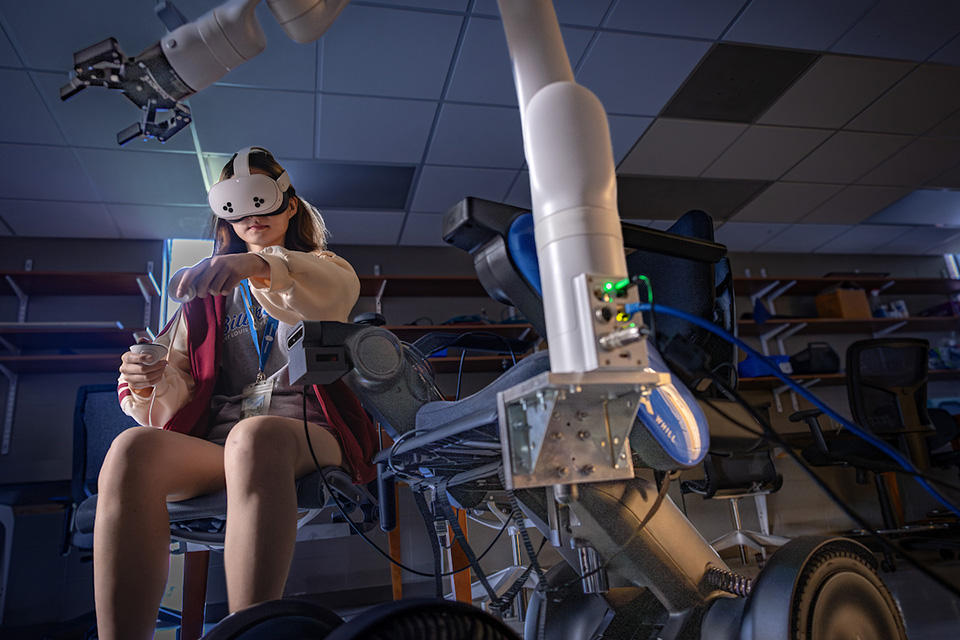
With the goal of assisting wheelchair users with everyday tasks, the WheelArm, a project out of the Mecharithm Lab led by Madi Dian, Ph.D., an assistant professor of aerospace and mechanical engineering, is training robots to understand spoken requests and clarifying questions. Researchers use a virtual reality headset to remotely control WheelArm, a wheelchair-mounted robotic arm, while collecting data that can be used to train vision-language-action models.
Learn More About the Mecharithm Lab
Exploring Brain-Controlled Hearing Aids
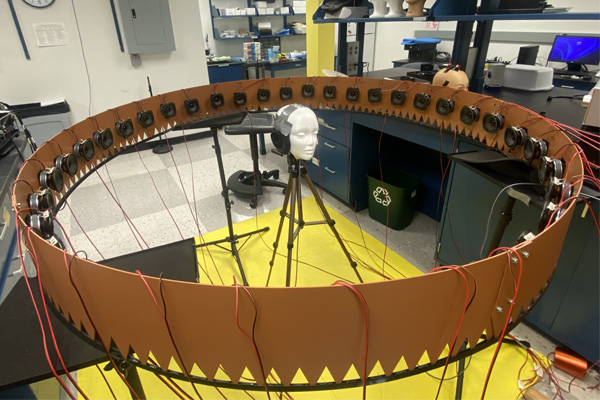
Hearing-aid users can face challenges in noisy environments with current-generation hearing aids. In the neuroengineering lab of biomedical engineering associate professor, Yan Gai, Ph.D., researchers are exploring how to improve that experience.
By first studying spatial auditory attention using electroencephalography, which uses sensors to monitor activity in the brain, the team was able to explore which direction a user is focusing on, allowing researchers to adjust their hearing-aid algorithm accordingly. From there, researchers are developing a physiologically based speech-segregation algorithm that selectively removes or attenuates unwanted sound sources. Ultimately, they're working to improve speech intelligibility for hearing-impaired listeners using robotic sensors and human-machine interface.
Developing Drug-Testing Sensors
Research out of the Baum Lab, led by associate professor of chemistry, Dana Baum, Ph.D., is looking to make work safer for first responders and treatment quicker for patients by developing rapid, simple-to-use sensors that can recognize drugs in the field.
Researchers in the lab are exploring the binding abilities of biomolecules, specifically single-stranded DNA and RNA molecules known as aptamers, for detection of desired targets — in this case, drugs that are of concern because of their abuse or misuse. By using these aptamers in sensors, researchers in the lab are looking to develop a more stable, cost-effective, and potentially safer option for situations in which drugs may play a role.
Advancing Perception and Embodied Robotics
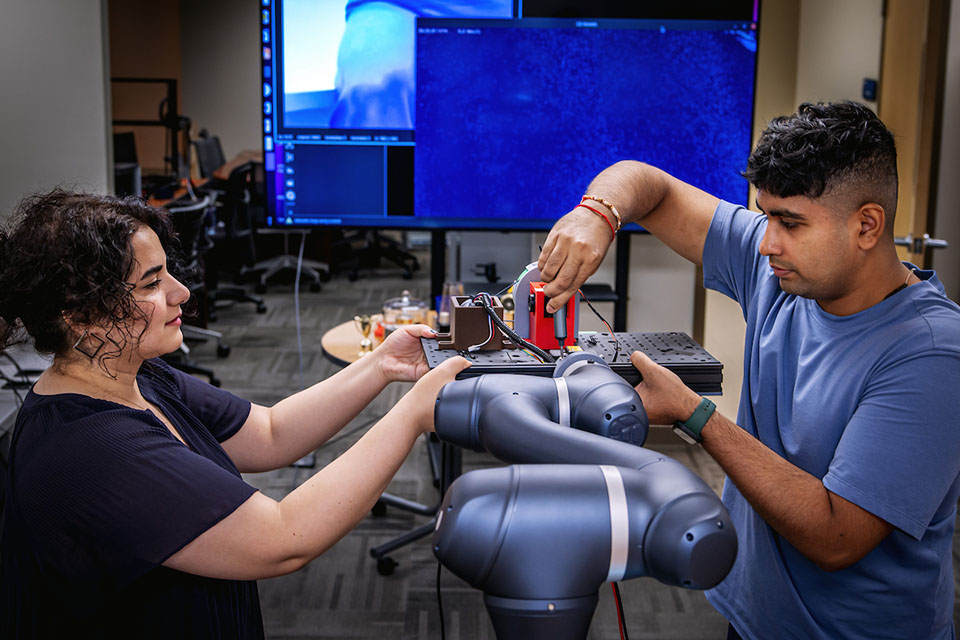
The AIRLab, led by Hadi Akbarpour, Ph.D., an assistant professor in the Department of Computer Science, is working to understand the physical world more reliably by combining complementary sensing technologies: Conventional cameras with emerging modalities like event-based vision and polarization imaging, machine learning, geometric computer vision and robotics.
This approach can help gather useful information in conditions where ordinary cameras struggle, like rapid motion, motion blur, strong illumination changes, reflective surfaces and scenes with limited visual texture. The team hopes to enable robots and autonomous systems to perceive complex environments more robustly, interact with their surroundings and make better-informed decisions about how to act in the real world.
Advancing Recovery for Achilles Tendon Injuries
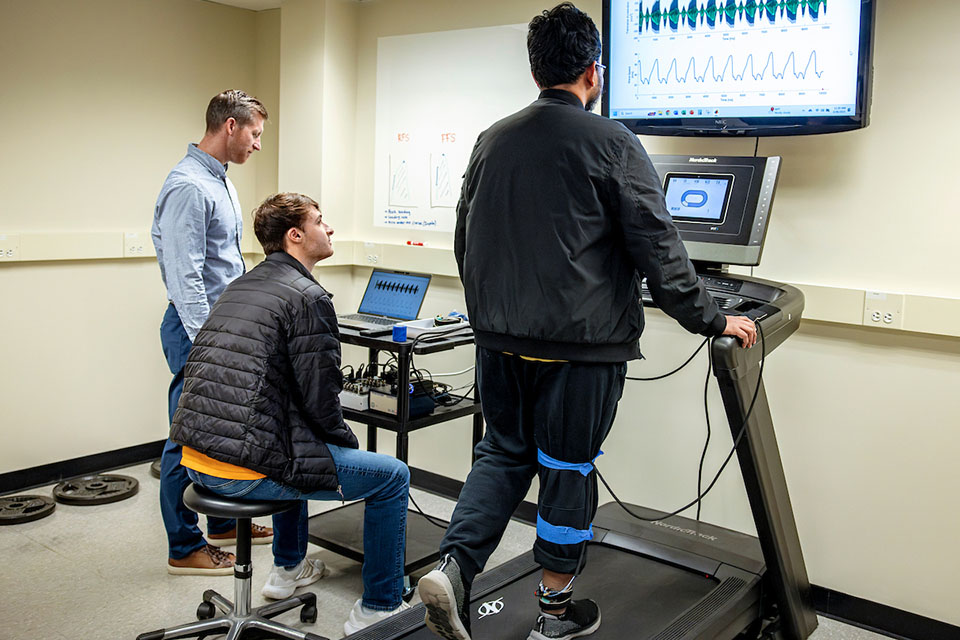
One of the most common injuries in sports is an Achilles tendon rupture, with recovery for the injury often lasting months. In the Musculoskeletal Biomechanics Lab, led by biomedical engineering assistant professor Alex Reiter, Ph.D., researchers are using wearable sensors to monitor this recovery process during real-world activities with the goal of improving the recovery period.
An interdisciplinary group of researchers in the lab collects data in the Integrated Health and Movement Science Lab and outdoors on SLU's campus, gathering measurements they hope can help clinicians monitor recovery, guide rehabilitation and assess readiness to safely return to activity. Researchers use wearable kinematic and kinetic sensors, including shear wave tensiometers, to directly measure tendon loading during movement.
Learn More About the Musculoskeletal Biomechanics Lab