


SLU Student Researchers Leverage Tech to Fight Mosquitoes
A look inside the citizen science Mosquito Alert St. Louis (MASTL) Project.
For nearly a decade, a quiet public health revolution has been unfolding across St. Louis, driven by the power of community collaboration and mobile technology. And at the forefront of this revolution are Saint Louis University faculty and students.
In a collaborative effort with the St. Louis County Department of Public Health, the City of St. Louis Department of Health and the Missouri Botanical Garden, faculty and students from SLU’s College for Public Health and Social Justice (CPHSJ) engaged with MASTL, the first project in the United States to promote the public use of the Mosquito Alert App, a participatory mosquito-borne disease surveillance platform originally developed in Barcelona, Spain.
A recently published paper, “App-Based Mosquito Surveillance and Community Engagement in St. Louis: Insights from a Mixed-Methods Study Evaluation of the Mosquito Alert St. Louis Initiative,” in Citizen Science: Theory and Practice, captures the impact of this groundbreaking project on the St. Louis community.
The study revealed that educational webinars significantly boosted knowledge and pro-ecological attitudes about mosquito control and highlighted community partner organizations’ strong mission alignment with MASTL and real appetite for sustained collaboration. Conversely, there was disappointment as App downloads and sustained use remained limited. The conclusion was that passive digital engagement alone isn't enough, and reaching underserved communities will require tailored messaging and long-term partnership building.
“We tried to raise awareness about mosquito reproduction, how to prevent mosquito bites, etc. and the goal really was to get people to download and use the app,” said Ricardo Wray, Ph.D., professor of behavioral science and health equity at SLU, and lead author of the paper.
SLU students actively served as the driving force on the ground for the research.
“The students were very important participants in the in-person community outreach events,” Wray said. “More of the programmatic work, material design, social media planning, data analysis, and interviews with our community partners were carried out by the students.”
The student researchers who co-authored the article said their hands-on experience highlighted the cooperative nature of public health research.
“Working alongside an institution like the Missouri Botanical Garden, plus two health departments and a whole network of community organizations, meant I wasn't just executing a task list handed down by one PI in one lab. I was seeing how a public health intervention survives in contact with the real world,” said Vishani Nimish Patel, Ph.D., co-author and public health clinician and researcher.
Mira Mohsen, a Ph.D. candidate at SLU, said the opportunity “was not simply about observing how research is conducted. I was trusted with responsibilities that directly shaped the study and its conclusions,” she said. “MASTL allowed me to see SLU’s mission in practice because the project was built around collaboration with the St. Louis community.”
Students said they relished the chance to do meaningful, practical research.
“The biggest thing was seeing how research works outside of a classroom,” said Mehdia Hassan, a Ph.D. candidate in CPHSJ. “Working with Dr. Wray gave me a chance to see that process up close.”
Amanda Nothstine, a graduate student who worked on the project, said the community-based outreach illustrated to her the benefit of engaging the public in public health research.
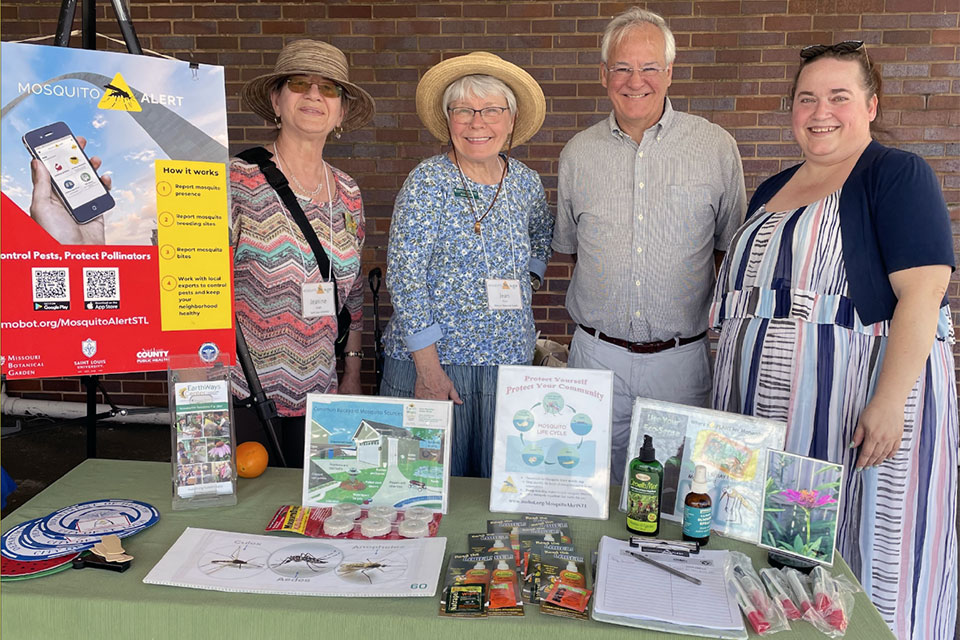
“The MASTL outreach consisted of tabling and educating community members on mosquitoes, the App, and the importance of citizen science in the community,” Nothstine said. “By educating the community members about this initiative, I feel like we have provided them with a resource they can use to directly improve the health of the community in St. Louis”
One of the strengths of the CPHSJ and Saint Louis University, Wray said, is the emphasis on service and social justice, mission and community engagement.
“I feel strongly that SLU and CPHSJ don’t just teach in a vacuum, rather they offer real-world insights to current problems affecting populations and teach us to think critically to mitigate or avoid future ones,” CPHSJ alumnus Reilly Agmon said.
The MASTL project started in 2021 and arose out of SLU’s relationship with local health departments and others engaged in public health research.
The study was led by corresponding author Ricardo Wray, Ph.D., along with Mira Mohsen, Amanda Nothstine, Reilly Agmon, Mehdia Hassan, Vishani Patel, all students or alumni in SLU’s College for Public Health and Social Justice; Jean Ponzi, Green Resources Manager at the EarthWays Center of the Missouri Botanical Garden; and Jeanine Arrighi, now retired from the City of St. Louis Department of Health.