


Giant Fluctuations of Focused Light Reveal Hidden Correlations in Complex Media
The SLU-led research in collaboration with Sorbonne Université reveals that giant fluctuations in wavefront-shaping enhancement provide a sensitive probe of hidden correlations in complex scattering media.
ST. LOUIS — When light travels through a strongly scattering material, such as biological tissue or other disordered opaque media, it follows many different paths and produces a seemingly random speckle pattern. Wavefront shaping makes it possible to control this complex interference and focus light through such materials.
The success of this focusing process is commonly characterized by the enhancement factor—a measure of how much brighter the optimized focus becomes compared with the diffuse background. While reproducible enhancement is essential for applications, much less attention has been paid to how the enhancement factor fluctuates from one realization or target position to another.
In a study published in Nature Communications, research led by Hasan Yilmaz, Ph.D., assistant professor in the Department of Electrical and Computer Engineering at Saint Louis University’s School of Science and Engineering (SSE), in collaboration with Professor Grégory Schehr of the French National Centre for Scientific Research (CNRS) and Sorbonne Université in France, reveals that these fluctuations contain information about the scattering medium itself. By combining optical experiments, numerical simulations, and random-matrix theory, the researchers uncover giant fluctuations in the enhancement factor produced by long-range mesoscopic correlations. The findings establish the enhancement factor not only as a measure of focusing performance, but also as a physical and statistical observable whose fluctuations provide a simple and experimentally accessible probe of the underlying correlations in complex scattering media.
“You can think of a complex scattering material as a maze for light,” said Yilmaz. “In our experiment, that maze is created by a layer of zinc oxide nanoparticles, similar to the particles that make paint appear white. The stronger the scattering or the thicker the material, the more light wanders through this maze before it escapes. These giant fluctuations carry a fingerprint of that journey, allowing us to learn about the material itself from the way the focused light fluctuates.”
The collaboration brings together Yilmaz’s expertise in wavefront shaping and complex photonics with Schehr’s expertise in extreme-value statistics, statistical mechanics, and disordered systems.
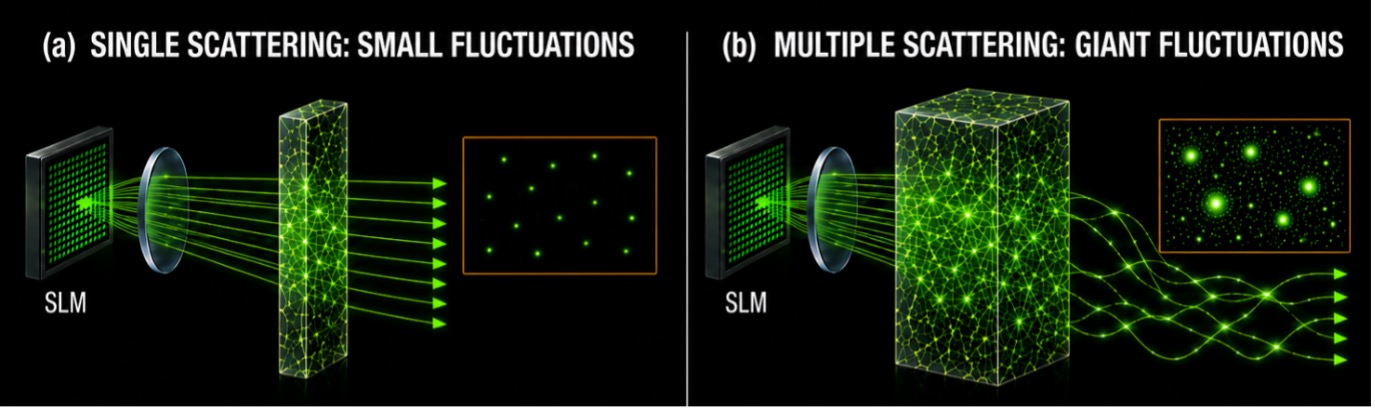
The researchers used finite-size Laguerre–Wishart random-matrix statistics to establish a parameter-free statistical reference for the enhancement factor. This framework accurately predicts both the average enhancement and its fluctuations when long-range mesoscopic correlations are negligible. Experiments and numerical simulations of strongly scattering media, however, revealed a striking contrast. While the average enhancement remains essentially unchanged, its fluctuations can become several times larger than the correlation-free prediction. Simulations further show that these giant enhancement fluctuations become increasingly pronounced as the scattering medium becomes thicker.
“What surprised us is that the average enhancement can agree remarkably well with theory while its fluctuations become giant,” said Yilmaz. “These giant fluctuations are not simply noise. They reveal hidden connections between the many paths that light takes through a complex scattering medium.”
These hidden connections are known in physics as long-range mesoscopic correlations. When light is scattered many times inside a complex medium, the different paths taken by the waves are not completely independent. Because the waves interfere with one another, what happens along one set of scattering paths can become statistically connected to what happens along others, even when they are widely separated.
These correlations are fundamental signatures of wave transport in disordered systems and are closely connected to hallmark phenomena of mesoscopic physics, including universal conductance fluctuations, highly transmitting open channels, and Anderson localization.
“Agreement between theory and experiment is always gratifying, but it is often when experiments depart from theoretical predictions that new physics becomes visible,” said Schehr. “That is precisely what happens here: the giant fluctuations expose long-range mesoscopic correlations that are not captured by the conventional random-matrix picture.”
The giant fluctuations uncovered in the study provide a particularly sensitive way of detecting these correlations. Conventional approaches based on transmission eigenvalues can require the measurement of very large transmission matrices containing thousands of input and output channels. In contrast, the researchers show that long-range correlations can be detected from dramatically smaller datasets—using fewer than roughly 200 controlled input channels and, in some cases, even a single output channel.
The findings could also have practical implications for applications in which exceptionally strong and reproducible focusing through complex media is important. In finite systems, the study shows that the average enhancement does not tell the whole story: in strongly scattering media, long-range correlations can produce giant fluctuations, greatly broadening the range of enhancement values around the mean compared with conventional correlation-free predictions.
This could be important for high-contrast imaging and high-precision optical metrology, where performance may depend not only on average focusing efficiency but also on the statistical likelihood of obtaining unusually large or small enhancement in individual realizations. The statistical description developed in the study provides information about achievable wave-control performance that cannot be obtained from the average enhancement alone.
The implications extend beyond optics. Because the underlying mechanism relies on multiple scattering and finite-size statistics rather than on properties unique to light, similar fluctuation physics may arise in acoustic, elastic, microwave, and matter-wave systems.
The study, “Largest eigenvalue statistics of wavefront shaping in complex scattering media,” published online on Sept. 30 in Nature Communications.