


Longest Table Brings Together SLU Community
A continuous web of white tables sliced through the heart of the Center for Global Citizenship on Thursday, Oct. 15, for The Longest Table. The event brought together members of the Saint Louis University community to share a single meal and engage in honest, uninterrupted dialogue.
Sponsored by the Office of Belonging, the Department of Communication, the Cross Cultural Center, the William L. Clay Sr. Institute for Civic Engagement and Economic Justice, and the Doerr Center for Social Justice, the gathering, rooted in the Jesuit spirit of cura personalis (care for the whole person), transformed a simple dinner into an active practice of community building.
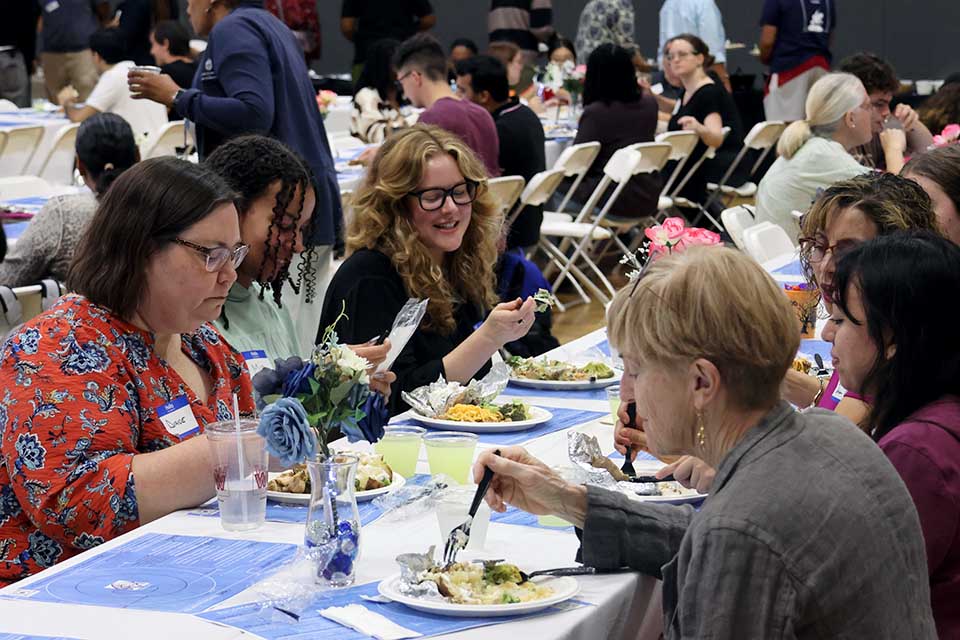
The initiative proved that fostering a true sense of belonging requires a shared, collaborative seat at the table.
“The longest table represents community, dialogue across differences,” said Rochelle Smith, vice president and chief belonging officer. “It represents breaking bread and sharing a meal together that is very communal and allows for a flow of conversation that can break open cultural bridges,” she said.
The concept was borrowed from a community event held in the Chelsea neighborhood of Manhattan, two years after the COVID 19 pandemic. The founders felt that after two years of physical distancing, it was time to get neighbors talking in real life again. So, they closed off the city street, rented and set up hundreds of chairs along a continuous line of tables, and invited the neighborhood to a massive outdoor potluck.
“I liked the idea of ‘come share a meal, pull up a chair, grab a plate,’ and get to know something about someone you didn't know,” said Karla Scott, Ph.D., professor of communication. “We know in our discipline that face-to-face interaction is valuable and important.”
Walking into the room, the sheer scale of the setup immediately commanded attention.
“Seeing the table stretch out like that completely changes the energy of the hall,” said Vivek Kumah, a graduate student. “I walked in not knowing where to sit, but I eventually found my table, and the people on it were great. They are not saying, ‘okay, we are in our circle, you should sit in your circle’. It was the kind of event where you are being included, to be honest.”
The conversations at the table touched on diverse life experiences, shared campus challenges, and personal hopes for the future. For the organizing bodies, the event was a live demonstration of how structured environments can foster pure human connections. Making sure every individual feels seen, heard, and valued.
Tim Huffman, Ph.D, professor of communication, highlighted the importance of building lasting connections and creating a safe space where people feel like they belong.
“Through dialogue, we can ultimately connect,” he said. “When you look at the layout, you can see that it is not a bunch of separate individual conversations, but ultimately one long continuous conversation. The thing that is being said all the way over there and the thing that is being said in the middle and all the way over here are different, but they are still connected by one human chain of ability to meet people where they are,” said Huffman.
Students appreciated the communal sharing and how the concept of belonging was operationalized.
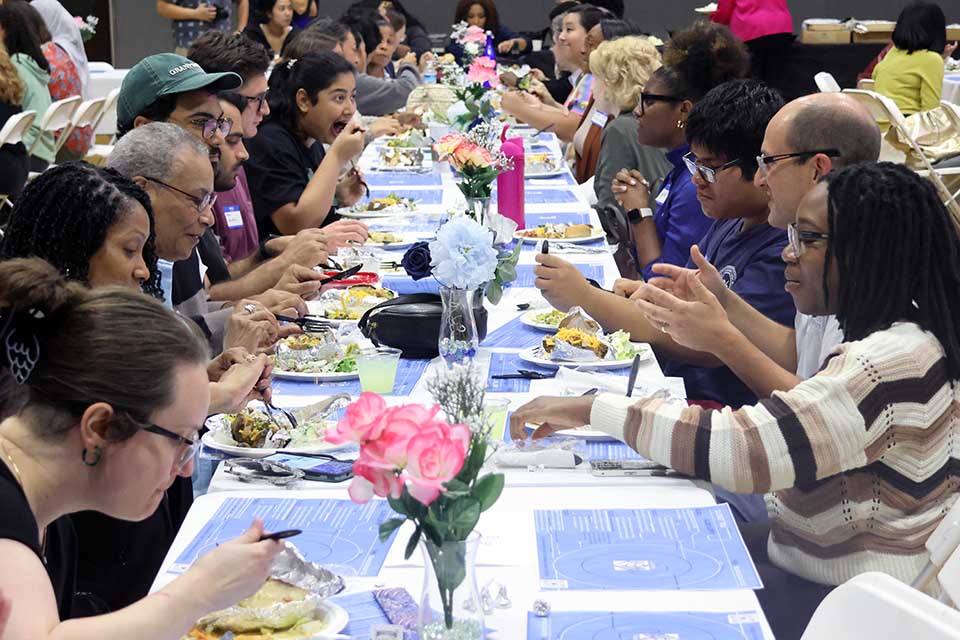
“What struck me was when everybody spoke, they had such diverse experiences than my own,” said Noah Apprill-Sokol, a graduate student. “When I define belonging, I think about the ability to have complicated, deep, challenging conversations, and still end with all of us being friends and understanding our feelings. And I saw that happen in my group. I saw that happen tonight. We really dived into topics we did not always agree on. And at the end, we were still able to look each other in the eye and smile and say that I see you, that I value you.”
Paulette Barry, a student in the Richard A. Chaifetz School of Business, said the event accomplished its goal.
“One experience I'm taking away is the sense of belonging,” Barry said. " I feel like I mean something to other people, and that is really good.”
Beyond the conversations, laughter, and shared meals, the event was wrapped in a musical halo, courtesy of Jasmine Wright, who treated the audience to a beautiful and carefully curated soundscape from her violin, giving the large open space a festive warmth.
The event closed with smiles on the faces of students, faculty, and staff as they filed out in pairs and groups, looking ahead to the future.
“When I think about this event and whether I want more … certainly. I think we'd be failing to live up to what we are as an institution to not have more events like this,” Apprill-Sokol said.