


How ‘Awkward’ Seminars Build First-Year Engagement
Today’s college students came of age in a world overcome by a pandemic, overloaded with information and obsessed with AI. They are understandably overwhelmed — and looking for an education that will address their academic and social needs in the present while preparing them for success in the future.
At Saint Louis University, applied learning begins in the undergraduate core. Every first-year student participates in an Ignite Seminar, a faculty-designed course that combines disciplinary exploration with discussion, collaboration and real-world problem solving.
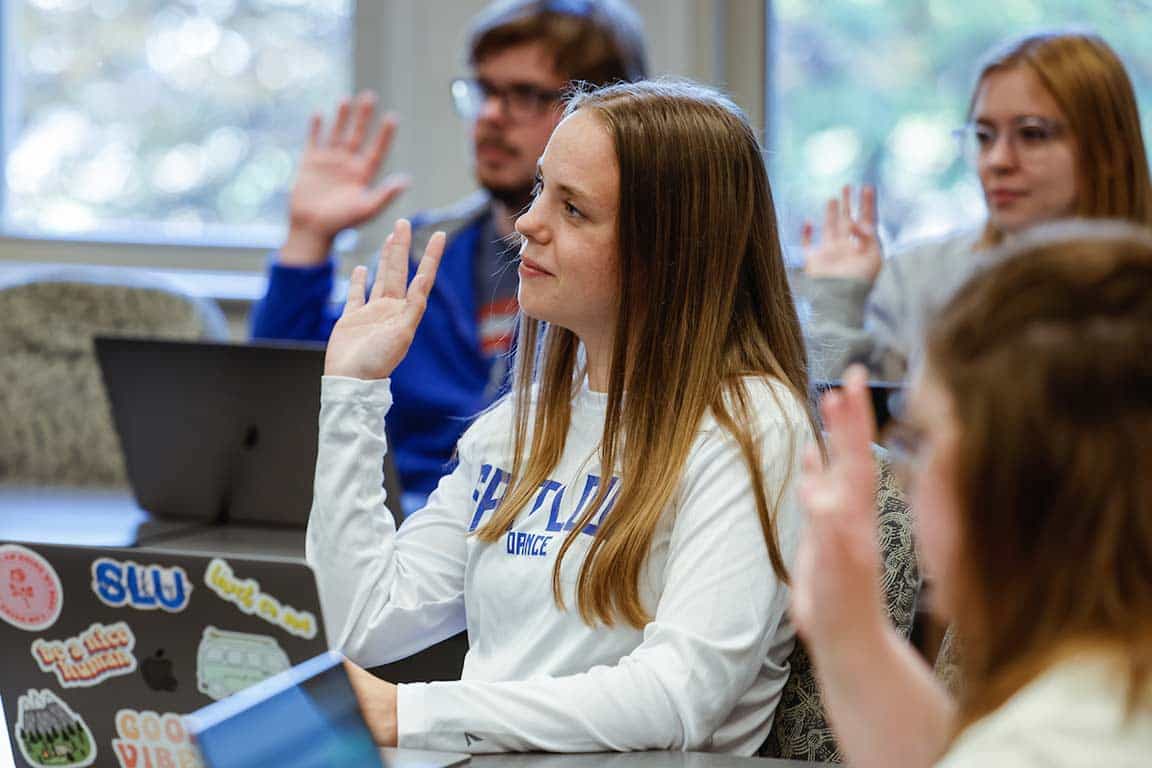
The first course in SLU’s common core curriculum, the Ignite Seminar introduces students to what makes a Saint Louis University education uniquely transformative.
Faculty design these seminars around their own scholarly and pedagogical interests: storytelling and city planning; healing arts and hacking; forensics, film, food. About 80 seminars are offered each academic year, and every new SLU student takes one. Two of the most popular, described below, are “Conversations with a Mom, but not Your Mom” and “Owning the Awkward.”
While the topic can be almost anything, every Ignite Seminar gives students ample opportunities to connect on a personal level and to practice problem-solving and people skills.
The result is a richer academic experience that promotes belonging, learning and future success.
Begin with Belonging
Dr. Shannon Cooper-Sadlo is a clinical professor of social work at SLU. She designed her Ignite Seminar, “Conversations with a Mom, but not Your Mom,” to address the specific needs of today’s undergraduates.
“One of the most important things for college success is for students to feel like they belong,” she said. “I try to be intentional about creating this little community where, if nothing else, they see 24 other friendly faces on campus.”
“Conversations with a Mom” starts with theories from psychology and social work to get students to consider how they are shaped by their experiences and how they impact their community.
Like every Ignite Seminar, Cooper-Sadlo’s is small and discussion-based. Encouraging her students to build affinity and trust early on leads to better participation and even vulnerability about the topics they tackle, including relationships, loneliness and grief.
Anina Montroy took the class when she transferred to SLU her sophomore year. She said Cooper-Sadlo’s accessibility inspired engagement in a varied class — athletes, sorority members, with lots of different majors.
“She was so approachable and easy to get to know, which set a good tone,” Montroy said.
Cooper-Sadlo balances serious subjects with lighthearted activities. She sends students on a scavenger hunt to get to know campus. She takes them to the rec center to play volleyball. She brings in guests to teach yoga. She gives extra credit if students go to a SLU Billikens basketball game.
“These are kids who grew up in front of a screen. A lot of times, they don’t seem to even know how to play,” she said. “It gets them engaged in the larger community. It shows them how to bring balance to their life.”
From Cringe to Confident
Dr. Carolyn O’Laughlin’s Ignite Seminar also centers on getting her students to open up.
An assistant professor who researches neurodivergence and success in college students, O’Laughlin created “Owning the Awkward” to teach that uncomfortable situations can lead to personal development, better communication skills and stronger communities.
“There’s so much we do to avoid feeling awkward. It feels weird to say, can I sit with you at lunch? So I sit alone and scroll on my phone,” she said. “But when we avoid awkwardness with other people, we miss out on what makes us human.”
O’Laughlin strives to create a safe space for students to address the things that make them cringe. The class might participate in an improv workshop or put together a “mortified gallery” featuring students’ most embarrassing moments. They explore awkwardness in media and research and learn strategies for coping.
The point is to connect through vulnerability, to increase resilience and to build a sense of community.
Senior America Gutierrez-Trejo said she has used what she learned in “Owning the Awkward” in situations from networking events to political conversations.
“It also helped me step into leadership roles without feeling like I need to have everything figured out,” Gutierrez-Trejo said. “I’ve learned to approach new experiences with curiosity and openness instead of fear of embarrassment, which has made a huge difference in both academic and professional spaces.”