


True Crime Meets the Classroom
The evidence is everywhere: True crime has captured the attention of the masses. Long-lived television series, scores of streaming documentaries, even podcasts that pipe stories of unsolved mysteries and cold cases into the collective consciousness.
It follows, then, that academic interest in forensic science is way up. At Saint Louis University, the Forensic Science Program is a boon of applied learning, drawing increasing numbers of students who seek real-world experience to jumpstart graduate work and scientific careers.
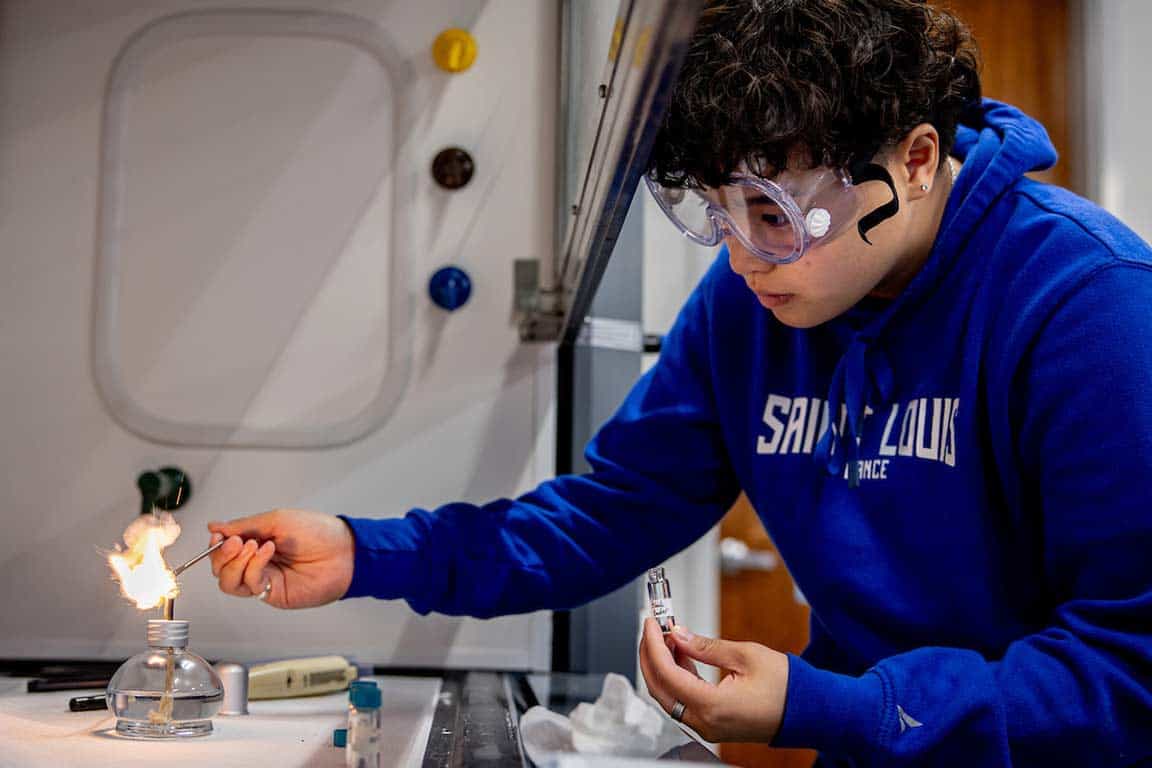
The study of forensic science at SLU barely existed 20 years ago. When Erik Hall, the director of SLU’s Forensic Science Program, began as an adjunct professor in 2012, the University offered only a forensic science minor. Hall has been instrumental in growing SLU’s program to great success.
“I started as director in the fall of 2020, in the heart of COVID. It was exciting but challenging because it had to be in person; in forensics, the work is definitely hands-on,” Hall said. “It’s picked up steam ever since.”
Like a perfect fingerprint or DNA evidence, the numbers don’t lie. Over the last five years, the number of students majoring and minoring in forensic science at Saint Louis University has more than doubled. In fall 2016, there were 15 SLU students majoring in forensic science; at the beginning of the 2025-26 academic year, there were 158 — more than 10 times the original group, in under a decade.
Hall began forensics work with the St. Louis Metropolitan Police Department Crime Lab, where he performed biological screening, crime scene processing, and DNA and bloodstain analysis for thousands of criminal cases during his 12 years there.
His trajectory is common among SLU’s faculty.
“Everyone has either worked in state, local or federal crime labs and units,” Hall said. “When we’re looking for new faculty, that’s one of the criteria: You need to have the experience.”
Faculty experience enhances SLU’s program in the classroom and beyond. In fact, Hall’s ties to the police department helped him build a robust internship program at SLU.
“It snowballed. Once one place takes our interns, another place thinks, clearly their students are good,” Hall said. “Now we have multiple medical examiner’s offices and coroner’s offices our students can get into. That is unique to SLU. And it’s invaluable for our students. They can go into a job interview and say, ‘I’ve done that technique.’”
The University encourages students to provide a forensics lens to cold cases as well as those involving missing persons or wrongful convictions by partnering with SLU’s criminology and criminal justice programs and outside agencies such as Missing in Missouri.
“They are actively trying to solve real cases,” Hall said.
SLU forensic science majors can lean into their interests, whether they want to end up in lab or on a crime scene. Those who want the latter can opt for SLU’s newest offering: an accelerated program to earn a bachelor’s in forensic science and a master’s in criminology and criminal justice in five years.
Regardless of the track, students start with a wide range of science courses.
“Saint Louis University providing such a strong foundation in those early courses is instrumental to us being able to do a successful forensic science major,” Hall said. “Whether it’s forensic biology or forensic chemistry, or something like bloodstain pattern analysis, where we’re applying physics and math to crime scenes — students need that background.”
This means SLU graduates aren’t limited to forensic work, and alumni find themselves working in hospitals, genetic counseling, pharmaceutical companies, and law, medical and even veterinary schools.
Most still want to help solve the crime. For them, the job outlook is terrific: According to the U.S. Bureau of Labor Statistics, prospects for forensic science technicians are projected to grow 13% from 2024 to 2034, much faster than the average.
Applied learning in school and great options after graduation? It’s a win-win for students — and for higher education.