


Reflection Series: Collaborations and Cures
A SLU Researcher Reflects on His Career in the Pursuit of Groundbreaking Collaborations and New Treatments
John Tavis, Ph.D., is a professor of molecular virology at the Saint Louis University School of Medicine and director of the Saint Louis University Institute for Drug and Biotherapeutic Innovation (IDBI). In this reflection, Tavis reflects on his more than three decades researching hepatitis B and how SLU enables interdisciplinary collaborations that can lead to life-changing treatments.
Question: In your own words, what does it mean to be a Catholic, Jesuit Carnegie “Research 1” university?
Being a Catholic, Jesuit Carnegie Research 1 university indicates to me that research at SLU is a key part of our mission to help others. Generating new knowledge for its own sake seems a bit sterile, but doing it in a way that can improve people’s lives, by developing new ways to treat illnesses, enriching their lives culturally or spiritually, or developing new tools to ease daily challenges, carries a deeper meaning to me.
You have studied hepatitis B for many years, and you were recently recognized at the International HBV Meeting with the Distinguished Award in Hepatitis B Research. Can you describe some of your recent research on HBV, and why do you think SLU is the right place to do this work?
Well, getting a lifetime achievement award tells me that I’m getting old! I have studied hepatitis B virus replication for almost 35 years, and have worked to develop new treatments for this frequently fatal infection since 2012. Our collaborative team has identified inhibitors of viral replication that are very powerful and work by a novel mechanism that we hope will eventually be included in the arsenal of treatments for HBV. SLU is the right place to do this work due to its strong history of outstanding virology research extending back to the 1960s, and due to the University’s support for the Institute for Drug and Biotherapeutic Innovation that helps SLU researchers advance drug development studies.
I have studied hepatitis B virus replication for almost 35 years, and have worked to develop new treatments for this frequently fatal infection since 2012. Our collaborative team has identified inhibitors of viral replication that are very powerful and work by a novel mechanism that we hope will eventually be included in the arsenal of treatments for HBV.
John Tavis, Ph.D., on his research of hepatitis B
As SLU continues to evolve as a preeminent research university, what impact do you hope the University will have on our understanding and treatment of HBV and other diseases?
I hope we can develop new cures for HBV and other diseases! Nothing would be more satisfying to me or be more responsive to SLU’s Jesuit mission in my eyes than stopping diseases such as HBV from destroying people’s lives. I also really, really want to determine the three-dimensional structure of the HBV polymerase protein that copies the viral genome. I’ve tried to do that off and on for about 30 years without success. We have a pretty good low-resolution predicted structure that my lab validated, but having an experimentally determined structure would be much more powerful with respect to its ability to teach us how this fascinating enzyme works and to develop advanced drugs against HBV replication.
You are the director of the SLU Institute for Drug and Biotherapeutic Innovation (IDBI), which brings together researchers across disciplines to advance drug discovery and development. What kind of collaborations has IDBI facilitated at SLU, and why are these collaborations important in drug discovery?
Drug discovery requires an extraordinarily wide spectrum of skills that are impossible for one person to have by themselves. For example, my HBV drug research requires deep expertise in synthetic medicinal chemistry, virology and pharmacology. IDBI exists to train SLU researchers in how to conduct drug discovery research and to help forge the interdisciplinary connections that are essential for success. Two good examples of this are how IDBI is trying to address the critical shortage of new antibiotics that is endangering people’s lives worldwide. First, we brought together a team of bioinformaticists, computer scientists, medicinal chemists and bacteriologists to conduct generative AI design of novel antibiotics, and then to synthesize and test the molecules designed by the computer against the six “ESKAPE” bacterial pathogens of high concern to the NIH. The second effort brought together expertise in structural biology, in silico drug screening, and bacteriology to identify highly promising inhibitors of mycobacterium tuberculosis that are good candidates to be developed into drugs to treat tuberculosis. Neither of these efforts would have existed without IDBI’s guiding hand and the resources IDBI provides to the SLU research community.
Most of the hands-on research at SLU is done by our outstanding students ... Each of those students obtains a deeper understanding of how research works: that it is not always “Eureka!” moments of insight, but instead is grinding and exacting work; that being wrong is very common and is OK as long as you change your perspective to match the data, and that science doesn’t seek to prove anything. It seeks to test ideas, and the outcome of those tests leads to deeper understanding.
John Tavis, Ph.D., on student research and how research enhances the student experience at SLU
How are students engaged in your research, either in your own lab or with SLU IDBI? How does SLU’s strength in research enhance the education offered to our students?
Most of the hands-on research at SLU is done by our outstanding students. Undergraduate students, graduate students and medical students are all deeply involved in research across the entire intellectual spectrum at SLU. For example, I’ve trained nine Ph.D. students, three M.S. students, and over 80 undergraduate and medical students in my lab at SLU, and I currently have one Ph.D. student and three undergraduates studying with me. Each of those students obtains a deeper understanding of how research works: that it is not always “Eureka!” moments of insight, but instead is grinding and exacting work; that being wrong is very common and is OK as long as you change your perspective to match the data, and that science doesn’t seek to prove anything. It seeks to test ideas, and the outcome of those tests leads to deeper understanding.
John Tavis, Ph.D.
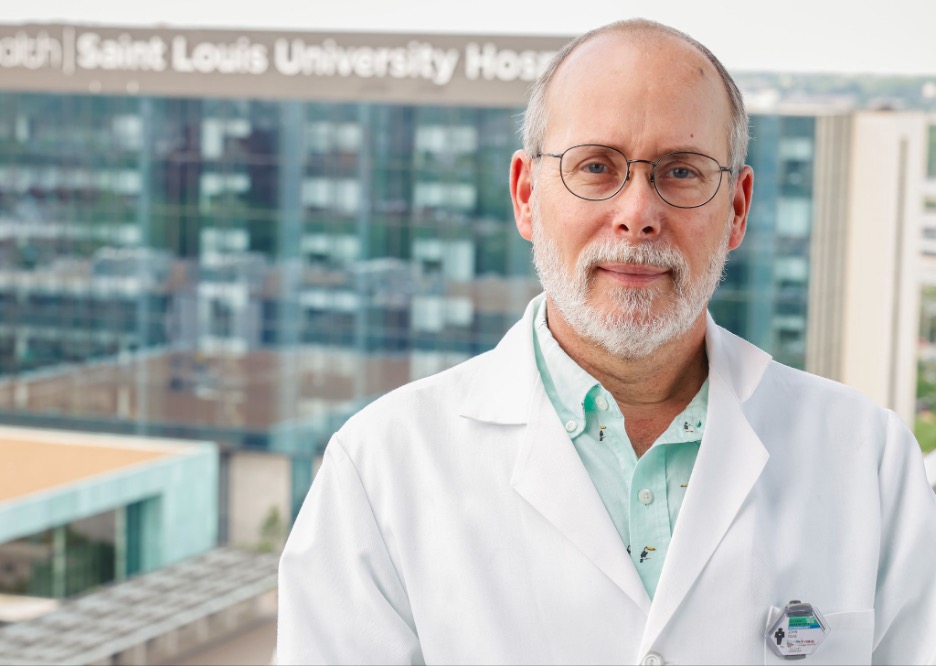
John Tavis, Ph.D., is a professor of molecular virology at the Saint Louis University School of Medicine and director of the Saint Louis University Institute for Drug and Biotherapeutic Innovation. He received his Ph.D. from Penn State University in 1990 and did postdoctoral studies at the University of California – San Francisco. He is chairperson of the Scientific Advisory Council for the International Hepatitis B Virus Meeting; past chairperson of the International Coalition to Eliminate HBV (ICE-HBV); a member of the Scientific and Medical Advisory Board for the Hepatitis B Foundation, and a member of the Scientific Advisory Board for the Comprehensive Hepatology Institute in Lyon, France. He is on the editorial boards of the Journal of Virology and Antiviral Research. His efforts to control HBV led to receipt of the 2013 Naomi Judd Award; the 2018 American Cancer Society’s Mission Hero Award; the 2026 Distinguished Award in Hepatitis B Research, and election as a senior member of the National Academy of Inventors in 2023. He has studied HBV replication mechanisms and HBV reverse transcriptase biochemistry since 1992. He has authored more than 130 scientific papers and is an inventor on 16 awarded or pending patents. His current work focuses on the biochemistry of the HBV ribonuclease H and developing anti-RNase H drugs.
This reflection is part of an ongoing series sponsored by the Office of the Vice President for Research (OVPR) in which SLU faculty, staff, and students reflect on the importance of being a Catholic, Jesuit, Carnegie "Research 1" university in this moment. Read other installments.