


Incarcerated Students Receive Diplomas at Prison Education Program Commencement Ceremony
The first Saint Louis University Commencement Ceremony of 2026 took place more than 50 miles from SLU’s campus.
Saint Louis University’s Prison Education Program celebrated its latest cohort of graduates on Monday, March 23, at the Eastern Reception, Diagnostic and Correctional Center in Bonne Terre, Missouri. The ceremony saw 14 incarcerated students presented with Associate of Arts Degrees from SLU’s College of Arts and Sciences.
“Graduating 14 students from our program is a significant accomplishment,” said Amanda Bequette, Ph.D., Prison Education Program executive director. “Earning a college degree is challenging in any context, and the carceral environment presents unique barriers that make persistence and completion especially difficult. Students must navigate factors that are often outside their control, such as a lack of technology, security disruptions, and other institutional constraints that can interrupt their studies.”
Saint Louis University's Prison Education Program provides accredited higher education opportunities to incarcerated individuals and prison staff in Missouri. The Associate of Arts in Liberal Arts degree is a rigorous academic program that mirrors the coursework offered on SLU’s campus. Students take 61 credit hours taught by SLU professors and complete the same high-quality curriculum expected of on-campus students, Bequette said.
The 2026 graduates completed the program in four-and-a-half years over multiple nine-week sessions, Bequette said. Throughout the time, they had to remain engaged with the program and tackle challenging work to earn a SLU degree.
“Their perseverance reflects both their dedication to learning and the transformative potential of higher education,” she said.
Monday’s ceremony was structured just like SLU’s commencement held in May. The Saint Louis University Student String Quartet provided the music, and the event opened with an invocation delivered by Tom Curran, S.J., coordinator of the Jesuit Prison Education Network.
SLU President Edward Feser, Ph.D., attended the ceremony and delivered remarks.
“It was a moving ceremony, and it was an honor to spend time with our graduates, their family members and guests, and the faculty and staff who have supported them on their journey to earn a SLU degree,” Feser said. “SLU’s Prison Education Program fosters a learning community that highlights, in a unique way, the potential of a Jesuit approach to education. It was a joy to celebrate the accomplishments of our graduates and to witness the lasting impact of SLU’s mission in action.”
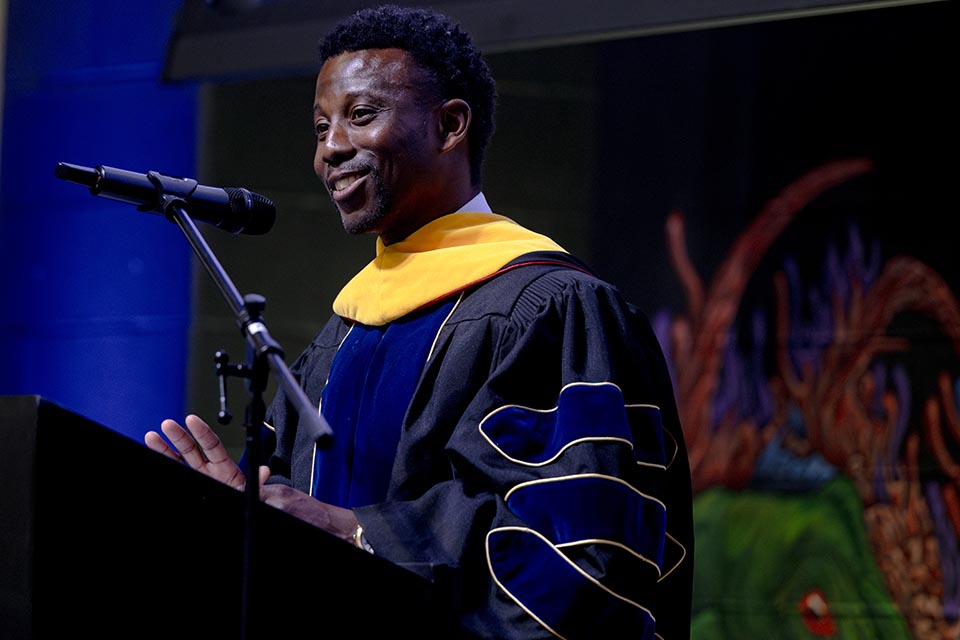
SLU alum Stanley Andrisse, Ph.D., (A&S Grad '14) an associate professor of physiology at Howard University and the executive director of From Prison Cells to Ph.D., delivered the commencement address.
Andrisse was incarcerated at a young age. While in prison, Andrisse decided to use education to change his life when he got out. He ultimately earned his doctorate from SLU.
Following the remarks, the degrees were presented by Feser and Donna LaVoie, Ph.D., dean of the College of Arts and Sciences.
Bequette said the goal of SLU’s Prison Education Program is to expand access to transformative, Jesuit education to individuals impacted by the criminal justice system in Missouri. She noted that the program was founded based on the Jesuit tradition of cura personalis, meaning “care for the whole person.”
“Program initiatives seek to educate and accompany our students in ways that support the development of mind, heart, and spirit,” she said. “Through rigorous academics and a strong learning community, the program fosters personal growth, critical inquiry, resilience, and a sense of purpose.”
Marking that journey with a traditional graduation ceremony is a key part of the mission, Bequette said.
“It recognizes the commitment our students have made to completing a college degree and affirms their accomplishments within a community of peers, faculty, family, and supporters,” she said. “The ceremony reflects the dignity of the achievement and celebrates the transformative power of education in the Jesuit tradition.”