


Reflection Series: Researching, Teaching, and Embodying Entrepreneurship
A SLU Researcher Reflects on Her Research in Entrepreneurship and How SLU Can Embody Entrepreneurial Values as a Preeminent Jesuit Research University
Jintong Tang, Ph.D., is the Mary Louise Murray Endowed Professor in Management, a Saint Louis University Research Institute Fellow, director of the Emerson Leadership Institute, and interim director of the Chaifetz Center for Entrepreneurship at the Richard A. Chaifetz School of Business. Below she reflects on her own research and the lessons SLU can learn as a research university.
Question: In your own words, what does it mean to be a Catholic, Jesuit Carnegie “Research 1” university?
Being a Catholic, Jesuit Carnegie “Research 1” university means encouraging students and faculty to use knowledge to make a meaningful difference in the world, advancing cutting-edge research that addresses complex societal challenges, building strong partnerships and contributing to the vitality and well-being of the St. Louis community.
Your research examines entrepreneurship and barriers for entrepreneurs. What are some of the barriers your research has identified, and how do you see this research advancing SLU’s Jesuit mission?
Entrepreneurship is still frequently stereotyped as a masculine domain, associated with traits such as aggressiveness and risk-taking, which can be perceived as inconsistent with traditional expectations of female characteristics. These stereotypes can limit access to resources, networks and legitimacy for women entrepreneurs, even when their ideas and capabilities are strong.
This research advances SLU’s Jesuit mission by helping us better understand how to expand opportunity and remove structural barriers so that more people can participate in innovation and economic development. By studying and addressing these barriers, the research encourages more inclusive entrepreneurial ecosystems that empower individuals and contribute to stronger, more equitable communities.
SLU is the right place to pursue this work because it has been a pioneer in entrepreneurship education ... SLU’s entrepreneurship program has been nationally ranked for more than three decades and has received multiple recognitions as a national model program, creating an ideal environment to advance both research and practice in entrepreneurship.
Jintong Tang, Ph.D., on the importance of researching and teaching entrepreneurship at SLU
How did you become interested in your research, and why is SLU the right place to do this work?
I became interested in entrepreneurship research because I have long been curious about what distinguishes entrepreneurs from non-entrepreneurs and how entrepreneurs succeed despite the many challenges and barriers they face.
SLU is the right place to pursue this work because it has been a pioneer in entrepreneurship education. The Richard A. Chaifetz School of Business began teaching entrepreneurship more than 50 years ago, at a time when many in academia were still debating whether entrepreneurship was a legitimate field of study. Since then, SLU’s entrepreneurship program has been nationally ranked for more than three decades and has received multiple recognitions as a national model program. Most recently, SLU’s undergraduate entrepreneurship program was ranked No. 15 nationally in the 2027 U.S. News & World Report rankings, further affirming the strength of an environment that advances both the research and practice of entrepreneurship.
How can researching and teaching entrepreneurial skills help us to address the challenges of today?
Researching and teaching entrepreneurial skills helps individuals develop the creativity, resilience, and problem-solving mindset needed to address complex challenges in today’s world. By encouraging collaboration across disciplines and breaking down silos, entrepreneurial education helps bring together diverse perspectives to tackle real-world problems. In this way, entrepreneurship education supports both innovation and the broader goal of serving the common good and strengthening our communities.
As SLU continues to grow as an R1 research university, dignity-based leadership reminds us that academic excellence and research impact should always remain grounded in human values, guiding how we conduct research, collaborate across disciplines, and ensure that discovery ultimately serves people and communities.
Jintong Tang, Ph.D., on embodying dignity-based leadership as a preeminent Jesuit research university
You are the director of the Emerson Leadership Institute at SLU, which promotes “dignity-based leadership.” How do you define “dignity-based leadership,” and how do you think SLU can embody “dignity-based leadership” as we continue to emerge as a preeminent research university?
Dignity-based leadership is a people-centered approach that begins with the belief that every individual possesses inherent worth and deserves to be treated with respect and value, no matter their role or status. It is vital to Jesuit education because it aligns deeply with the Jesuit mission of formation, not just development. When students learn to see and honor the dignity of others, they begin to lead from compassion rather than authority, forming habits of reflection, humility, and service, all core Jesuit values.
As SLU continues to grow as an R1 research university, dignity-based leadership reminds us that academic excellence and research impact should always remain grounded in human values, guiding how we conduct research, collaborate across disciplines, and ensure that discovery ultimately serves people and communities.
That commitment is also taking shape beyond the classroom through the recent launch of DISTL: the Dignity-Based Leadership Initiative for St. Louis, convened through the Emerson Leadership Institute. DISTL brings together leaders and organizations across the region to learn from one another, strengthen people-centered organizational cultures, and explore how dignity-based leadership can become a distinctive strength of the St. Louis community.
Jintong Tang, Ph.D.
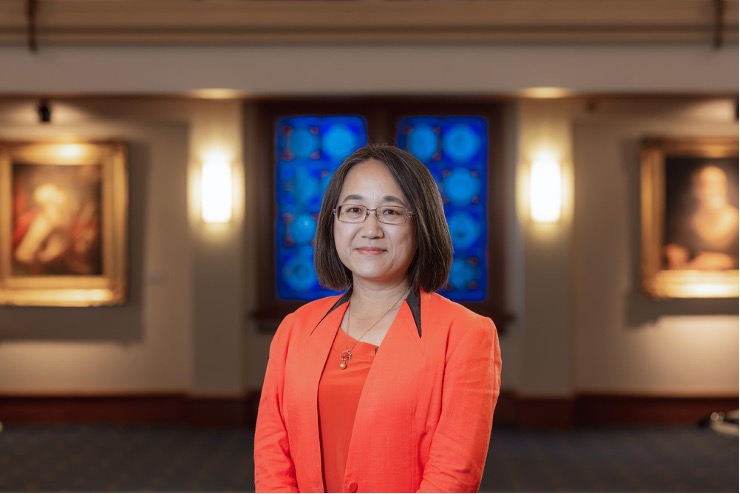
Jintong Tang, Ph.D., is Mary Louise Murray Endowed Professor in Management, Research Institute Fellow, Director of the Emerson Leadership Institute, and Interim Director of the Chaifetz Center for Entrepreneurship at Chaifetz School of Business. Her research has appeared in approximately 100 refereed/invited journal publications and more than 130 refereed/invited conference proceedings. A highly accomplished academic and educator, Jintong has been ranked “2% or above top-cited scientists in the world” for single recent year impact by Stanford University’s author databases of standardized citation indicators, every year since 2019 when the database was established.
This reflection is part of an ongoing series sponsored by the Office of the Vice President for Research (OVPR) in which SLU faculty, staff, and students reflect on the importance of being a Catholic, Jesuit, Carnegie "Research 1" university in this moment. You can view previous installments here.