


After the Storm
In the wake of a deadly tornado, Saint Louis University found myriad ways to show support and solidarity with the St. Louis community.
Friday, May 16, 2025, started like many mid-May days at Saint Louis University. As the whirlwind end of the semester was winding down, celebrations were ramping up. Campus bristled with excitement as graduates and guests arrived for Friday’s six precommencement ceremonies, and the whole SLU community looked forward to Saturday’s main commencement.
Friday seemed a great day to celebrate, dawning warm and full of sunshine. But as the day went on, the atmosphere transformed. Then the warnings started.
Around 2:30 p.m., Debbie Pike (Grad CSB ’92) stepped to the podium onstage at Chaifetz Arena to present the graduates from the Richard A. Chaifetz School of Business. Minutes later, emergency signals sounded on phones throughout the arena, interrupting the litany of names.
Pike, associate dean for undergraduate education at the business school and an associate accounting professor, held her composure. She had spoken several times that morning with SLU’s Events Services team and Department of Public Safety.
“I want you all to know that this is the safest place. We are not near any glass. We are down low in the ground,” she said calmly, as the crowd started applauding. “I won’t dare the weather to disrupt our ceremony, but we’re going to just keep on going.”
The ceremony proceeded undisrupted, but outside, severe thunderstorms beat the St. Louis area.
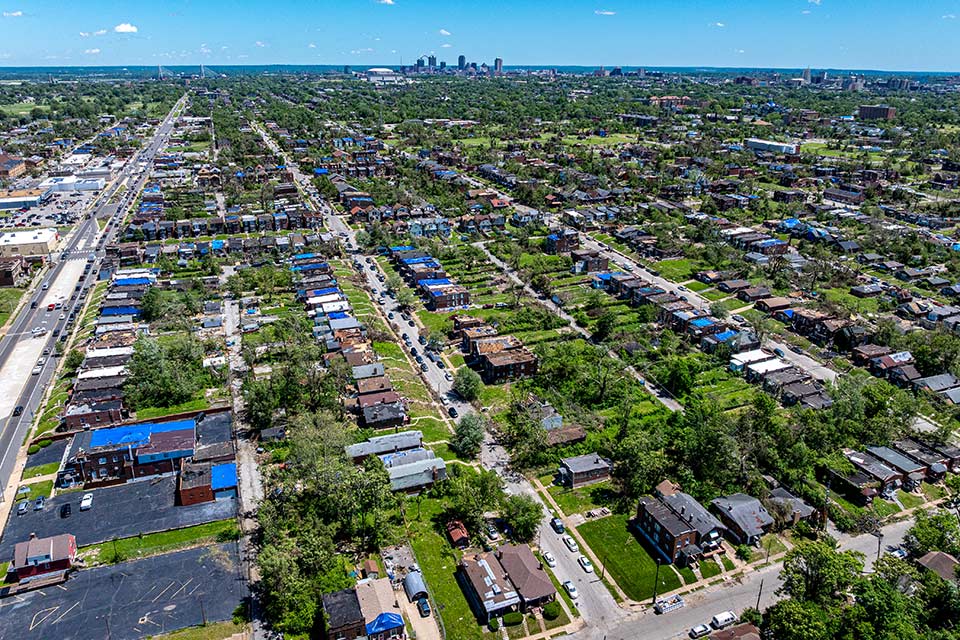
Around 2:40 p.m., a tornado touched down in Clayton, seven miles from the University. The storm quickly moved northeast for 23 miles through north St. Louis City before crossing the Mississippi River and lifting in Illinois.
The nearly-mile-wide tornado ravaged the ground for almost half an hour, the wind whipping up to 152 mph.
In the wake of the storm, five people were dead and 38 more injured. More than 5,000 buildings had been badly damaged or destroyed, with total damages estimated at over $1.6 billion to St. Louis.*
While Pike kept the precommencement on track, she ignored texts from her husband, who was working from home in the Central West End, less than two miles from SLU. The tornado blew the roof off their historic condo building and knocked out more than 40 windows in the complex.
The next day, Saint Louis University hailed its newest graduates at commencement and turned to the city it calls home in support and solidarity.
University leaders set the tone in a message to the SLU community: “In moments like these, our mission calls us not only to prayer but also to action grounded in the Ignatian ideal of cura personalis — care for the whole person. Thank you for all you are already doing to lift up those around you, and we stand ready to walk with you in the days ahead.”
Picking up the Pieces
The relief effort in St. Louis started as triage: clearing huge, fallen trees that made streets impassable, securing tarps where roofs had been blown off, feeding residents who could no longer cook or even sit in their homes. The devastation was vast, especially in north St. Louis City, where buildings had been torn wall from wall, reduced to rubble.
To encourage volunteering, the University gave employees each one full day to spend on relief efforts, without loss of pay or the need to use vacation. Individuals and groups representing various colleges and schools, offices and athletic teams answered the call.
“Saint Louis University stepped up to the plate when the horrific and devastating tornado took place in our city,” SLU Trustee Michael McMillan (A&S ’97) said.
If everyone lived out the Jesuit mission, then this type of work would be a no-brainer for everyone all the time.”
Michael McMillan, SLU trustee and president and CEO of the Urban League of Metropolitan St. Louis
McMillan is president and chief executive officer of the Urban League of Metropolitan St. Louis. He and his organization worked closely with the University to harness the capacity of the SLU community.
According to McMillan, SLU provided “hundreds of hours of volunteerism from students, faculty and staff, members of the board of trustees, and even the first lady of the University herself.”
In addition to serving in person, the SLU community was encouraged to donate supplies. The on-campus Tornado Relief Donation Drive technically took place over four days in early June, but McMillan said it continued much longer.
“After the drive, there were people still bringing things and running smaller efforts as well. As a result, tens of thousands of dollars of food, clothing, cleaning supplies and PPE materials were gathered around campus and shipped to the Urban League to be distributed to victims of the tornado,” he said.
McMillan, who has spent his whole career in service to the St. Louis community, said, “If everyone lived out the Jesuit mission, then this type of work would be a no-brainer for everyone all the time.”
Health and Well-being
Volunteers with SLU’s Mobile Health Clinic certainly embodied the Jesuit mission as they served in the tornado-ravaged Fountain Park neighborhood a couple of weeks after the storm.
Faculty, staff, residents and students from the School of Medicine, Doisy College of Health Sciences and the College for Public Health and Social Justice went door to door, checking on community members.
Did they have power and internet service? Access to their medications? Had they eaten?
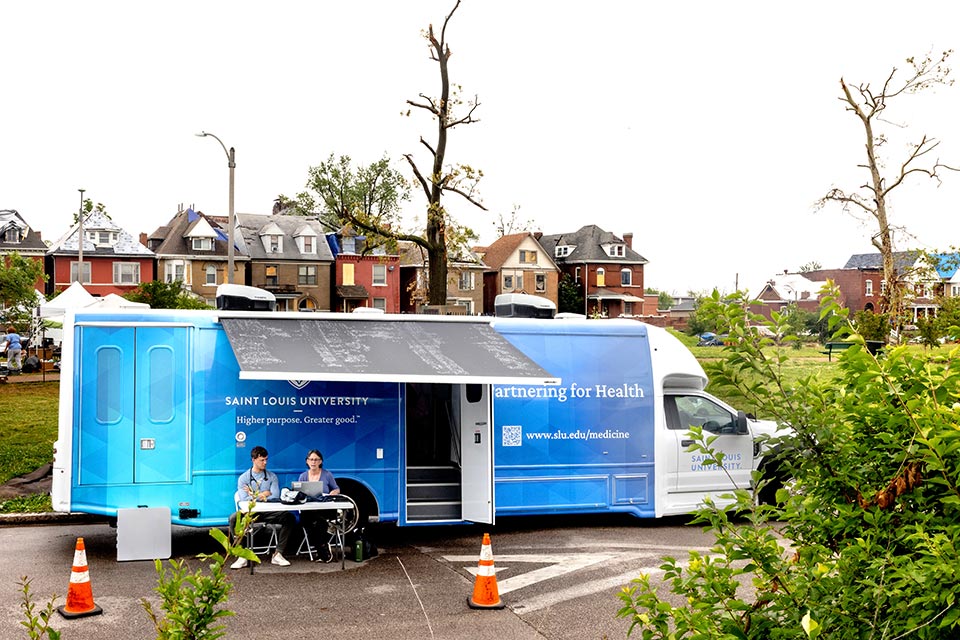
After connecting with residents, volunteers regrouped at the mobile clinic to check blood pressures, hand out sunscreen and write prescriptions. Some people just needed a place to rest.
“We heard their stories about how they survived the tornado and how many of them are pitching in to help each other out,” said Dr. Angela Cecil, an associate professor of occupational science and occupational therapy. “They also expressed gratitude for the help they’ve been receiving from mobile clinics like SLU’s and other outreach efforts.”
SLU started the mobile clinic in May 2022 after receiving federal funds to serve St. Louisans who lack nearby health care facilities, transportation to clinics or the technology for telehealth.
Reflecting on the recovery effort, Cecil said, “I was impressed by the resilience and strength of each resident whom we encountered, despite challenges that are now compounded by the loss and uncertainty of life and recovery after the tornado.
“It was both humbling and an honor to volunteer,” she said. “I hope the goodwill of the community continues until this neighborhood and others recover.”
Prayers and Fellowship
The same week the mobile clinic ministered to Fountain Park residents, the University opened its doors to faith communities that had been devastated by the tornado.
On June 5, St. Francis Xavier College Church hosted an interfaith service of prayer, community and hope in solidarity with congregations whose worship sites had been affected by the storm.
Tim McMahon, S.J. (A&S ’80), canonical pastor of the College Church and a SLU trustee, welcomed the participants, who included not just tornado victims but also College Church parishioners and friends. Pastors from three local congregations preached and offered their reflections. Afterward, everyone gathered for fellowship at a reception.
Nicci Roach, special assistant to SLU’s president, helped plan the event in coordination with the College Church and SLU’s Division of Mission and Identity.
“The room was so filled with heart,” she said.
Assistance on Campus
Across campus, Chaifetz Arena became a Disaster Assistance Center (DAC).
Opened June 9 through a partnership led by the City of St. Louis with the Missouri State Emergency Management Agency, the DAC brought together more than 30 government agencies, nonprofits and faith-based groups to provide coordinated support.
In the weeks that followed, people from hundreds of households visited the DAC for help navigating the recovery process. Survivors were able to access a range of services, including financial assistance, legal and insurance guidance, housing resources, health care and emotional support.
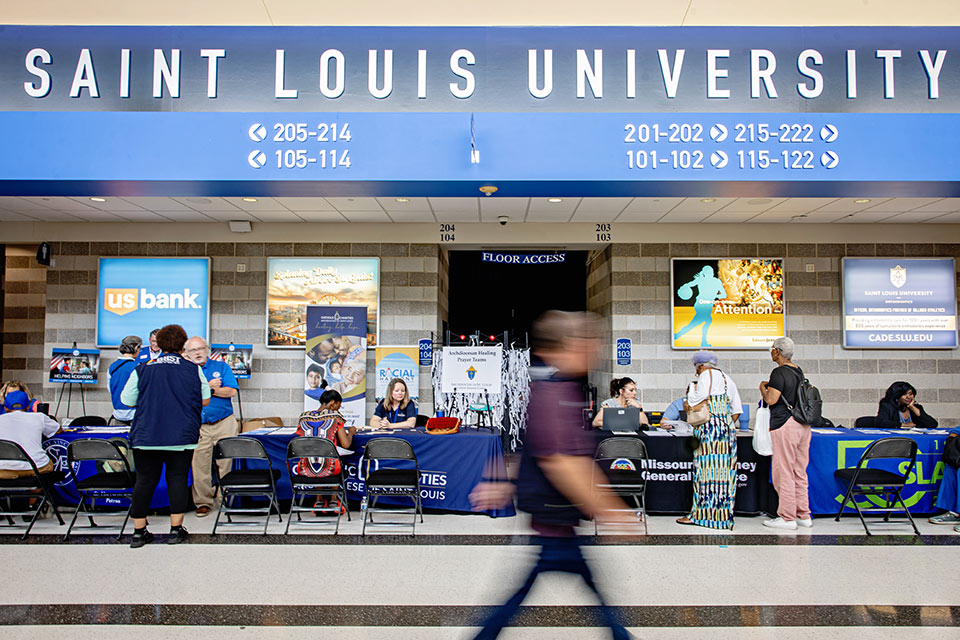
SLU provided both the venue and logistical backing for the multi-week effort. University leaders described the initiative as a natural extension of SLU’s mission.
Although the campus had been spared, dozens of members of the SLU community felt the impact of the tornado in a tangible way. The University encouraged affected faculty and staff to reach out to SLU’s Division of Human Resources (HR) for direct support, while students could contact the Office of the Dean of Students.
According to Tom Vonderheid, senior director of human resource operations, 26 employees contacted HR in the days that followed the tornado and received time off, financial assistance, help with temporary housing and more. HR referred some people to Helping Our Own, a program funded by SLU employees to help each other during financial crises, as well as the University’s Employee Assistance Program, which offers free, confidential counseling.
Donney Moroney, assistant vice president and dean of students, said that the Student Emergency Relief Fund provided a total of $31,600 to 25 students to assist with temporary accommodations, relocation fees, food and other essentials.
Commitment to the Community
Summer wore on, and the University settled into another academic year, but the region still reeled from the effects of the tornado. A disaster of that magnitude simply could not be overcome in short order — full recovery will entail long-term commitment.
Rochelle D. Smith, SLU’s vice president and chief belonging officer, addressed this with the SLU community.
“Though efforts began in earnest immediately after the tornado, it is crucial we remain steadfast in our support of our neighbors and neighborhoods most impacted in the journey ahead to recovery,” Smith said. “As we continue to accompany one another through the aftermath of the storm, let us remain grounded in our mission and shared commitment to be men and women for and with others.”
* Information from the National Weather Service St. Louis
This story was published in the spring 2026 issue of Universitas. To learn about how some SLU alumni responded in the aftermath of the tornado, read Alumni Take Action After the Disaster.
About Universitas
Universitas, the award-winning alumni magazine of Saint Louis University, is distributed to alumni, parents and benefactors of the University. The magazine includes campus news, feature stories, alumni profiles and class notes, and has a circulation of 103,000.