


Alumni Take Action After the Disaster
After the May 16, 2025, tornado in St. Louis, some Saint Louis University alumni across the area served in the short term, while others made an extended commitment with the intention of lasting investment in the community.
Here are just a few of their stories.
In the Streets
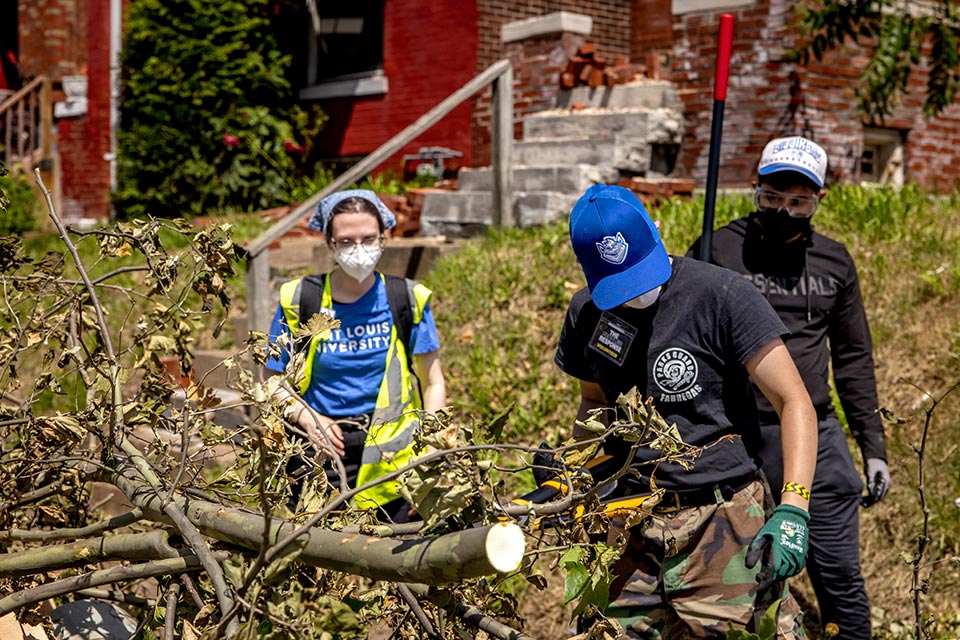
Birch Fabregas (A&S ’25) was on campus packing up her Marchetti East apartment when the tornado hit. After the “all clear” message, she didn’t hesitate to go headlong into the wreckage.
“That’s the kind of person I was raised to be: If you see someone raising a hand for help, you take that hand,” she said.
For Fabregas, that meant skipping her commencement the next day so she could move out of her apartment and start volunteering as soon as possible.
First, she emailed Kyle Foerst, adjunct faculty in the College for Public Health and
Social Justice, who had
taught her emergency management course at SLU.
“He gave me a list of what to wear — work boots, gloves, mask, sun protection — and told me not to self-deploy but to get involved in a directed way,” Fabregas said.
She found her way to The People’s Response, a relief hub led by Action St. Louis and ForTheCultureSTL. For the next three weeks, she dedicated all of her time to the recovery effort: surveying residents, climbing trees to cut down dead limbs and translating for Spanish speakers in need.
She quickly became a team leader, directing dozens of volunteers. And she relied on
her SLU network to
recruit more help.
Fabregas and her twin sister Greer (A&S ’25) posted on social media to rally friends
and sent a Google
form to former professors to share with their students. They organized carpools from
campus to service sites. Fabregas was impressed with how many SLU students served,
especially international students.
The work “was heartwarming but also heartwrenching,” she said. “The most important part was that I was never alone. It was collective action in the face of adversity.”
One Block at a Time
On the day of the tornado, attorney Mark Timmerman (Law ’17) was running errands, getting ready for a party the next day. At Timmerman’s house, handyman Calvin Motley was painting a nursery. Neither one could have known how the storm would bring them together.
When Timmerman checked in with Motley on May 17, the day after the tornado, he learned
that Motley’s
house, in the Penrose neighborhood, had lost half of its roof. He had already mostly
repaired it and was
preparing to help others on his block.
Soon thereafter, the two men hatched a plan for STL Rebuild.
Timmerman told Motley, “You’re a master craftsman. You’re already repairing the neighbor’s
homes. What
if you were somehow paid to continue to do this every day?”
He helped Motley launch a GoFundMe and promoted it on social media. He called on connections in public service and media he had made through the Ferguson Commission, where he clerked during law school.
The initial goal of $5,200 quickly became $10,000 and then $50,000.
“The idea is to tackle Calvin’s block and the immediate area, so that the repair work is manageable and the block can become a model for other places — anywhere disaster strikes or a neglected area that needs to rebuild themselves,” Timmerman said. “It’s making a difference in a different way than we anticipated.”
STL Rebuild clearly has made a difference in Timmerman’s life; his long-term goal is to redevelop a corner building in Penrose and move his law firm there.
“This is a calling,” he said. “It’s one of the things that brings me the most joy and purpose that I’ve ever felt in my life.”
Local Weatherman
Matt Beitscher (Grad A&S ’20) wasn’t in St. Louis when the May 16 tornado hit, but as a meteorologist at the National Weather Service St. Louis (NWS STL), his work was integral in the aftermath.
“The core responsibility of the NWS STL is to produce an hourly, seven-day forecast for the 46 counties we serve,” Beitscher said. “We start with a model, and then we use our expertise and knowledge of the local patterns.”
Local, historical knowledge can provide crucial information that a weather app might not.
“On the weather apps on the day of the tornado, people were seeing a 10% chance of rain. That was it. No mention of severe weather,” Beitscher said. The National Weather Service offers more nuanced and helpful information, “because of meteorologists in the area. Our office was talking about the threat of severe weather five days in advance. The day of the event, we were concerned with very large hail and strong tornadoes.”
We’re there to console people and to listen. We always consider the intersection of weather and society.”
Matt Beitscher (Grad A&S ’20), meteorologist at the National Weather Service St. Louis
Local meteorologists then go into the field as soon as possible to survey damage and, eventually, arrive at a strength rating for the tornado. The preliminary results for the May 16, 2025, event came out a couple of days later: EF-3, a category with wind speeds from 136 to 165 mph.
EF stands for “Enhanced Fujita,” a scale for rating tornadoes that was formulated after decades of studies by meteorologist Dr. Ted Fujita. Beitscher said the scale balances “two components, empirically derived: the damage indicator (what was hit?) and the degree of damage (how bad it was hit?), plus mitigating factors.”
For example, surveyors look for uprooted trees but also consider how large they are and how healthy the root ball looks. All of that specific information gets factored into calculating the EF number.
“There’s an intricacy to the work,” Beitscher said.
Also, a humanity.
“We’re there to console people and to listen,” he said. “We always consider the intersection of weather and society. Everything we do is muted by the societal impact.”
Advocates for Residents
When Kimberly Turner (Law ’14), an attorney and realtor, volunteered for tornado relief, she quickly realized that her professional expertise could be an asset.
“People were being told that their home was condemned, that if it has a red sticker, they no longer own it. To sign a quitclaim deed to give over rights to your home because it’s not worth anything anymore. It was heavy on my heart,” Turner said. “I felt that God was saying, ‘You can give out essential items. But what can you do as an attorney and a realtor?’”
What she did was help found The Coalition, which comprises attorneys, law students, realtors and insurance claim experts, as well as organizations including SLU law school’s Black Law Student Association (BLSA).
The Coalition protects and supports homeowners and tenants in St. Louis City whose homes were damaged or destroyed by the May 16 tornado. Volunteers help safeguard property rights, maximize insurance claim outcomes and ensure that people are not exploited or displaced, so the community can rebuild.
As long as we’re needed, we will be available to the community.”
LaShonda Lambert-Howze (Law ’08), lawyer and volunteer with The Coalition
Days after the storm, the group created a “Know Your Rights” flyer, which they distributed through community hubs and shelters and by canvassing. They also established a weekly insurance claim hub to provide on-site legal and claims assistance and partnered with FEMA to help the community complete applications.
LaShonda Lambert-Howze (Law ’08), a senior counsel for Schnucks Markets Inc., got involved right away. Her house was damaged by the tornado, and she was already serving as an expert for her neighbors.
“I had a lot of people knocking. So, I just started walking around to my neighbors, asking if they understood what this process would look like, what resources they would need,” she said.
“It was like a second storm, because not only had they lost their homes, resources and paperwork — but they’re dealing with insurance companies, attempting to get contractors to get bids, not able to obtain resources from FEMA,” Lambert-Howze said.
The Coalition started distributing essentials through community partnerships.
Robert Beckles, who is pursuing a dual degree in law and social work at SLU, was involved with The Coalition through BLSA when he connected the group with Feeding Families, a program at SLU’s Doerr Center for Social Justice in the School of Social Work. Feeding Families delivers nutritious food to families facing severe food insecurity in St. Louis City and County and was funded at the time by the University’s 1818 Community Engagement Grant Program. The partnership with The Coalition led to more than 350 meals for residents over the summer.
The Coalition is committed to continuing for the duration.
“As long as we’re needed, we will be available to the community,” Lambert-Howze said.
This story was published in the spring 2026 issue of Universitas. For more about Saint Louis University's response in the aftermath of the May 2025 tornado, read After the Storm.
About Universitas
Universitas, the award-winning alumni magazine of Saint Louis University, is distributed to alumni, parents and benefactors of the University. The magazine includes campus news, feature stories, alumni profiles and class notes, and has a circulation of 103,000.