


Experiential Learning at SLU
Experiential learning (sometimes referred to as applied learning) is learning that occurs when students engage in intentionally designed “real-world” experiences that require them to apply the knowledge and skills developed in their SLU courses.
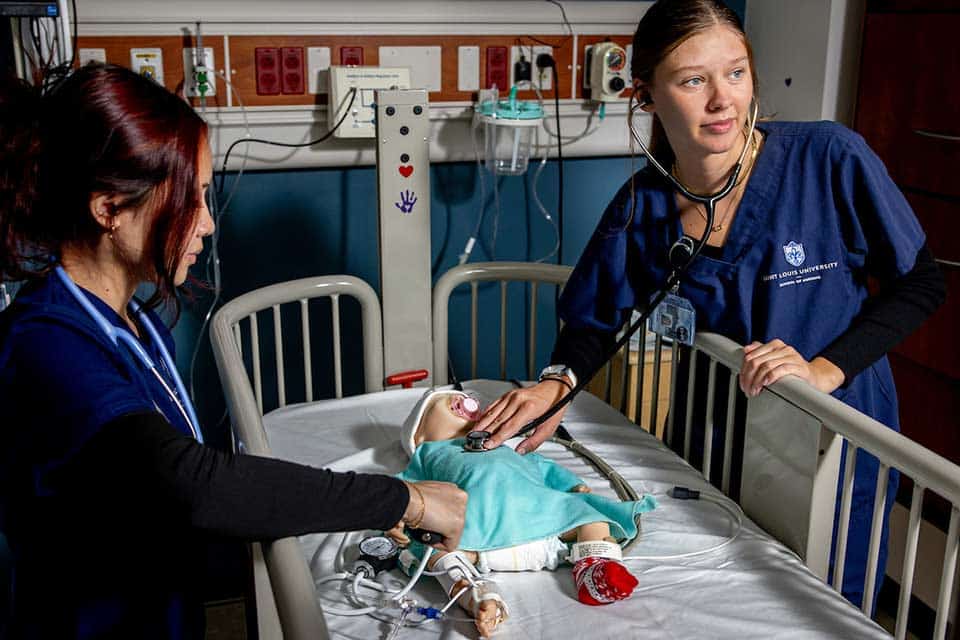
Experiential learning enables students to experience and learn from both the successes and challenges of that application of knowledge. Accordingly, experiential learning at SLU:
- Requires students to reflect on, critically analyze and synthesize elements of the experience
- Requires students to take initiative, make decisions and be accountable for the results
- Engages students intellectually, creatively, emotionally, socially and/or physically
- Occurs in professionally-mentored contexts that mitigate the consequences of mistakes while strengthening capacity for future success
Experiential learning happens in many different contexts, and to varying extents. At a micro-level, well-designed case studies, simulations and problem-based learning exercises embedded in countless SLU courses are examples of experiential learning. Even certain intentionally-designed and mentored co-curricular and extra-curricular experiences can foster substantive experiential learning.
But a hallmark of SLU’s undergraduate education is the opportunity for all students — in all academic programs — to participate in dedicated, credit-bearing courses designed either exclusively or primarily for experiential learning. SLU awards academic credit for the following categories of experiential learning courses:

Categories and Definitions of Formal Experiential Learning at SLU
Research, scholarship or creative activity is an inquiry, investigation, or project conducted by a student that leads to an original intellectual, scholarly or creative contribution to the discipline or profession. The activity involves a four-step process:
- Identification of the research problem, scholarly question or creative work to be addressed by the project
- Acquisition of the disciplinary (or interdisciplinary)/professional methodology to address the research problem, scholarly question or creative project
- Execution of the project under the guidance of a faculty mentor either as an individual project or a group project and either as part of or in addition to the student’s class curriculum
- Dissemination of the student’s discoveries or creative activity to the student’s peers, the SLU community, and/or non-SLU experts in the student’s discipline
These activities may include traditional undergraduate and graduate research directed at discovery and development in the natural and social sciences, education and business; traditional scholarship in the humanities; creative development of designs, ideas and performances in the arts, including juried exhibitions and performances; and design and performance studios. Often, projects in this category extend beyond one semester.
Community-engaged learning experiences (sometimes referred to as “service learning” experiences) are those that generally take place within a course and that integrate academic material, relevant community-based engagement and/or service activities and critical reflection. Community-engaged learning typically involves a reciprocal partnership among students, faculty/staff and community members, and/or organizations. The experience is intentionally designed to achieve academic and disciplinary learning objectives along with civic outcomes.
Note: Although many SLU courses require community service, not all community service experiences embedded within a course constitute “service learning” or community-engaged learning.
Study abroad is an international educational experience outside the United States that fulfills global perspective and academic learning objectives through academic credit. SLU offers semester/academic year study abroad options, as well as short-term (typically seven to 14 days) faculty-led options. Educational exchanges, and options with affiliate and non-affiliate programs, are also available.
The experiential learning component is the cultural immersion in which students encounter challenges related to living in a new place and cultural context and in which they practice cultural competency and, often, language fluency skills. The coursework connected to a study abroad experience can also include internships and service-learning experiences.
Similar to study abroad, study away is an immersive learning experience that takes place away from SLU’s campuses, typically involving living in locations of historical, artistic, literary and/or natural significance — but within the United States. Like study abroad, study away may take place over a shorter term (seven to 14 days) or over a longer term (up to a semester or full academic year).
The experiential learning component typically involves direct contact with artifacts, locations, natural elements and/or people, as well as the mentored application of theoretical/course-based knowledge. Coursework connected to a study away experience can also include service-learning/community-engaged learning experiences.
A practicum is an experiential learning opportunity in a discipline-related professional context. Knowledge, theories and skills learned in academic contexts are applied in “practical situations” within an occupational field.
Note: Depending on the associated academic discipline, the term “practicum” is often used synonymously with terms such as “field experience,” “clinical,” “internship,” “student teaching,” “clerkship” and others.
A clinical is a specifically defined experience in which students practice and apply learned didactic and experiential skills, most frequently (but not exclusively) in health care and legal settings, under the supervision of a credentialed practitioner. Clinical courses are often tied to related theoretical courses or other “capstone”/culminating courses in academic programs.
Note: Depending on the associated academic discipline, the term “clinical” is often used synonymously with terms such as “field experience,” “practicum,” “internship,” “student teaching,” “clerkship" and others.
A field experience (or field placement/fieldwork) course provides substantial professional experience under the supervision and mentorship of a licensed professional or an individual otherwise qualified to supervise in the context of SLU’s academic program learning outcomes.
Note: Depending on the associated academic discipline, the term “field experience” is often used synonymously with terms such as “practicum,” “clinical,” “internship,” “student teaching,” “clerkship” and others.
Consistent with the definition of “internship” adopted by the National Association of Colleges and Employers (NACE), SLU formally defines internships as follows:
Internships are a form of experiential learning in which students apply knowledge and theory learned in the classroom in professional work contexts – either in-person, remote/virtual, or hybrid – under the direct supervision and evaluation of an experienced employee of the company or organization in which the intern works and (because the internship involves academic credit) evaluation of a SLU faculty member. Internships enable students to explore career paths, foster students’ personal and professional development, and establish and expand students’ professional networks.
Internships are intentionally designed to support the integrative application of theoretical/classroom-based knowledge into practice. Accordingly, internships require an appropriate base of undergraduate- or graduate-level disciplinary/professional knowledge directly related to the internship work.
SLU-sponsored/designated internships are codified as credit-bearing SLU courses in students’ official academic records and on SLU transcripts. They are taken by current SLU students who work with both the employer and SLU faculty/staff in determining (in advance) the internship learning outcomes, required experiences, and the nature of and responsibility for the evaluation of an intern’s performance or learning achieved. Generally, a SLU faculty member from an academic discipline closely associated with the professional work of the internship serves as the faculty of record for a credit-bearing internship. The SLU faculty member observes and/or solicits evaluative feedback from the employment site supervisor on the student’s internship-based learning and performance to assign the internship’s course grade. The amount of credit awarded for an internship is determined by the associated SLU faculty and must adhere to SLU’s credit hour policy.
Note that non-credit, non-course internships may be taken by SLU students but do not involve SLU faculty in determining any internship learning outcomes, required experiences, or any evaluation of an intern’s performance or learning achieved. No SLU academic credit is awarded, nor are any such internships recorded in any official SLU academic records or on any SLU transcripts.
Generally, SLU faculty do not vet or otherwise explicitly endorse the nature or quality of the internship experience when SLU academic credit is not awarded. This includes the vast majority of non-credit, non-course internship opportunities available to current and past SLU students via the Handshake employment database provided by SLU’s Office of Career Services. The inclusion of such non-credit, non-course internships on Handshake or any other such employment or career-building database is not an endorsement by SLU of the nature or quality of the internship experience.
As an expression of our commitment to equity, and echoing NACE’s position statement on unpaid internships, SLU’s expectation is that interns should be paid by their host employers for their work. However, SLU recognizes that
- per the U.S. Department of Labor, under certain circumstances internships may be unpaid; and
- unpaid internships within small non-profit organizations may have meaningful educational benefits for students, even when the organization is not able to provide compensation.
A co-op (short for cooperative education) alternates or combines semesters of academic study with internship-type work experience in appropriate fields as an integral part of degree plan completion and career advancement. A co-op involves a partnership among students, SLU and employers that formally integrates students’ academic study with work experience in employer organizations (again, like SLU-designated internships).
Co-ops themselves are generally not offered for academic credit, but are sometimes offered in combination with an academic, credit-bearing experience. Unlike non-credit internships, non-credit co-ops can satisfy institutional and federal financial aid requirements for continuous enrollment at SLU.
Each of these is further defined below. Note that the amount of credit awarded for any experiential learning course is determined by the associated SLU faculty and must adhere to SLU’s credit hour policy.